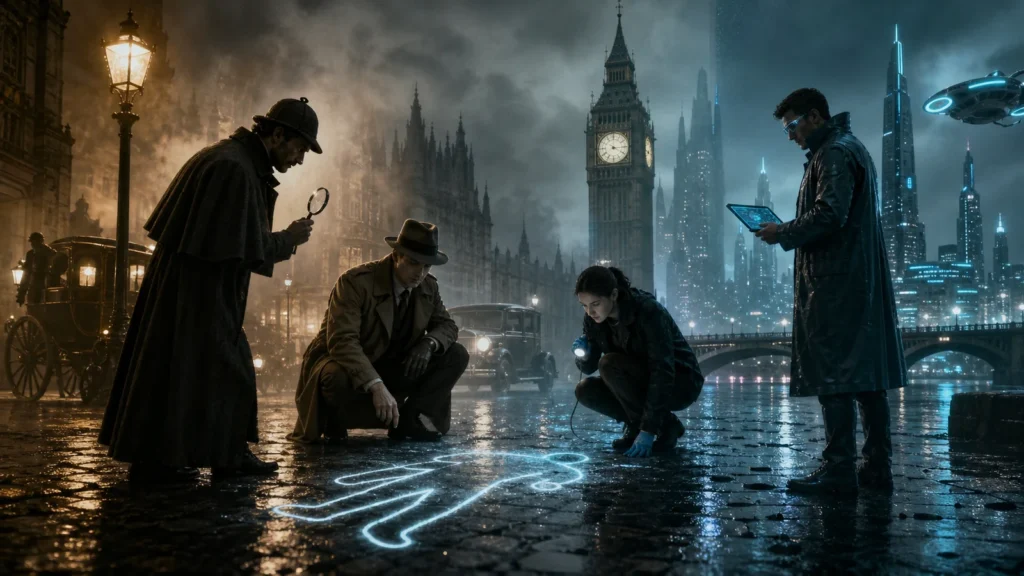
Bodies turns a police investigation into a temporary mechanism. The same body appears in Longharvest Lane, London, in 1890, 1941, 2023 and 2053. Four detectives separated by more than a century and a half follow traces that respond between eras. The series, created by Paul Tomalin based on the graphic novel by Si Spencer, uses mystery to explore a loop where a person is both the result and architect of their own story.
This text contains spoilers for the entire series. We will analyze the body of Gabriel Defoe, the journey of Elias Mannix, the KYAL organization, the genealogical paradox and the ending. You can complement the reading with our guide the bootstrap paradox and the closed time curves.
Four crimes that are one
Alfred Hillinghead investigates Victorian London; Charles Whiteman, in the middle of World War II; Shahara Hasan, in 2023; and Iris Maplewood, in the technological regime of 2053. They all find Defoe's naked body with the same wound and a strange symbol. Repetition allows four genres to be told: historical drama, noir, contemporary thriller and dystopia.
The corpse has not been copied voluntarily. Defoe enters “the Gorge,” the temporal anomaly, while being shot. Interference divides your arrival into several destinations. Your body becomes a message distributed over time. Each detective discovers a part because none of them alone has a perspective outside the loop.
Elias Mannix: his own origin
In 2053, Mannix rules a society built after the nuclear explosion of 2023. He travels to 1890, adopts the identity of Julian Harker, and creates the family that will eventually lead to his own birth. He also founds an organization that preserves recordings, orders and relationships necessary to guarantee the explosion and its rise.
This is a genealogical bootstrap paradox. Mannix exists because his adult version travels back and becomes an ancestor of himself. There is no first Mannix external to the circuit. The slogan “Know You Are Loved” also functions as circular information: the phrase travels between generations and maintains the cult that produces the future from which it was sent.
The role of each detective
Hillinghead identifies connections that threaten the life constructed by Harker. His investigation is repressed, but leaves emotional traces. Whiteman starts out as a corrupt cop and ends up protecting Esther, revealing that a person trapped in a system can make an unforeseen decision. Hasan understands that the bomb and the teenager Elias are linked by a machinery of manipulation. Maplewood, initially loyal to the regime, discovers that its stability depends on a historic crime.
Detectives don't talk face to face; They communicate through files, brands, photographs, records and decisions. Bodies treats the archive like a slow time machine. A preserved inscription can change an investigation one hundred and fifty years later without violating any laws of physics.
The Throat and physics
Gabriel Defoe studies quantum gravity and describes the Gorge as a temporal singularity. The series does not offer sufficient equations to evaluate it. Its behavior is reminiscent of a portal that connects several points of the same geometry and can launch matter both into the past and the future.
In relativity, a wormhole hypothetical could connect separate regions and, under certain conditions, produce a temporal lag. This does not imply that an injured person is distributed symmetrically between four dates. Defoe's multiplication is a visual license to transform the victim into the structure of the story.
Fixed line or modifiable history?
For much of the series there seems to be a self-consistent line: Mannix always traveled to 1890, the bomb always exploded, and messages were always deposited. The loop has no origin, but its pieces fit together. The ending introduces a changeable story when Hasan convinces Elias to record a different message. That doubt reaches the elderly Mannix and weakens the chain of decisions.
If the past changes, the society of 2053 built after the bomb disappears. The series thus combines two models that in conceptual physics are usually kept separate. Dramatically, the transition makes sense: consistency depends on Mannix believing in his own inevitability. When a version of it withdraws consent, the loop loses its human support.
KYAL's false determinism
KYAL presents the future as inevitable, but devotes enormous resources to producing it. That contradiction is revealing. If the outcome were guaranteed by the laws of the universe, there would be no need for generations of agents, planned marriages, and sealed recordings. The organization calls a logistics operation a destination.
The series distinguishes between knowing a prophecy and obeying it. Each character receives a role, but can reject it. Freedom does not appear outside of causality; It appears when someone interprets inherited information in a different way.
Maplewood's Last Taxi
In the non-explosion reality, Hasan rides in a taxi driven by Maplewood, who pronounces KYAL. The scene may suggest that there are remnants of the erased chronology, that Maplewood made another trip, or that a different structure is attempting to create the same regime. It doesn't invalidate the ending; Remember that eliminating a loop does not eliminate the social conditions that made it attractive.
Frequently asked questions
Why do several Defoe bodies appear?
The series indicates that he enters the Gorge while receiving the shot and his trajectory fragments into different years. It's a fictional portal rule, not an effect proven by physics.
Is Mannix your own grandfather?
In causal terms, it is part of its own genealogy. Traveling as Julian Harker starts the family that leads to Elias. It's an extreme version of the bootstrap paradox.
Did the loop always exist?
In the main chronology there is no visible first turn. The cycle sustains itself. The ending shows that he can become destabilized when the information Mannix receives from his own versions changes.
Conclusion
Bodies uses time travel to investigate how inevitability is manufactured. The corpse connects eras, but it is the archives, the institutions and the desire to be loved that maintain the circuit. Its greatest paradox is not that Mannix is its own origin; It is that an entire society accepts future violence because it has confused it with destiny.
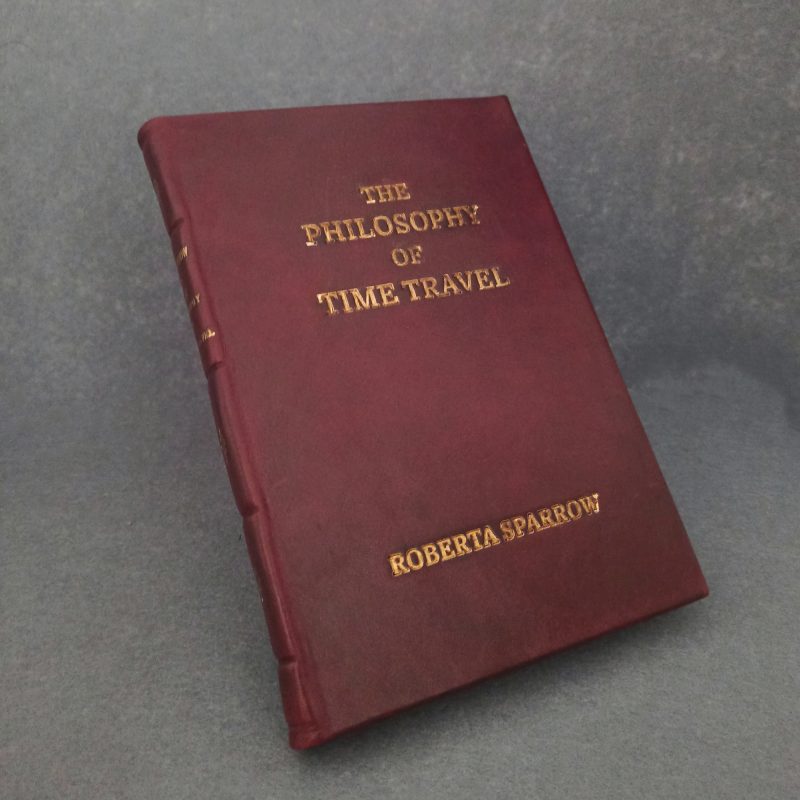
Reading for chrononauts · Limited edition
Philosophy can also cross time
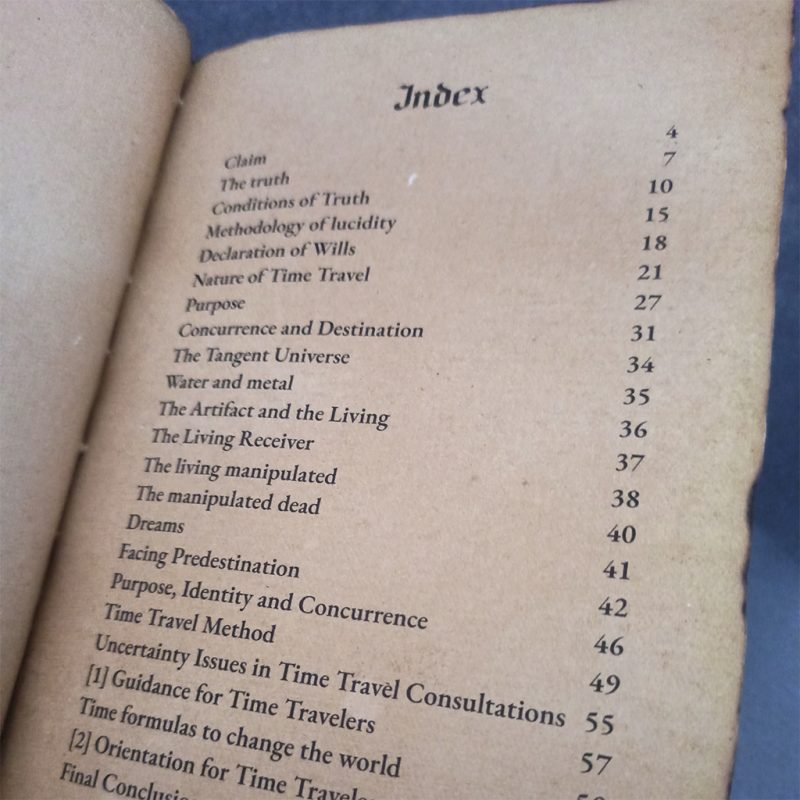
A handmade work that explores the temporary traveler ethics, the concurrence of timelines, destiny and an introspective method to explore one's own history.
- Philosophy and moral standards for time travelers
- Tangent universes, causality, purpose and identity
- Illustrated and handcrafted A5 format
The file, availability and purchase are managed in Verbalus Mater.