Once again based on an article of Yaiza Martínez in order to explain a recent theory about the formation of memories in our brain:
When we live any experience (we see an object, we learn to drive, we are scared), a “neural trace” or neuronal circuit exclusive to said experience is formed in our brain; a unique brain “imprint” that constitutes ‘a memory’ of that experience. In principle, this is how the memories in our brain.
For now, it is known that this process can give rise to various types of memory (short or long term), which in some way is related to emotions; and also that it has a surprising intrinsic materiality (for example, has been achieved record production of proteins in neuronal connections or synapses at the time of the creation of a memory).
 On the other hand, there is antimatter. It doesn't seem to have much to do with memories, but we'll soon understand the relationship. In physics, antimatter is called a form of matter made up of antiparticles, that is, particles like those of ordinary matter, but with an opposite charge.
So antimatter is like a “mirror image” of matter: Instead of electrons, it has antielectrons or positrons (positively charged electrons); and instead of protons, it has antiprotons, which are negatively charged protons.
One of the most interesting discoveries of the last century physics was the discovery of antimatter, as it increased our understanding of the universe and the laws of physics. According to scientists, at the origin of the universe matter and antimatter existed in equal proportions, although later matter “triumphed” over antimatter for reasons that are not yet fully clarified, and that has made it possible, among other things, that we are here today writing-reading this article.
Well, now an explanation for memory is being proposed that is very close to the concept of antimatter: researchers from the University of Oxford and University College London (UCL) point out that antimemory exists, that is, when new connections are created between neurons (in the formation of a memory), at the same time a pattern of neuronal electrical activity is generated exactly opposite to that new 'neural trace'.
Scientists believe that, in this way, Through 'anti-memory', the brain maintains the balance of its general electrical activity. This theory is supported by research carried out with rats and mice and with mathematical models, reports The Conversation.
As we have said, when we learn something, the connections between neurons increase (increased arousal). Despite this, brain electrical activity levels normally remain finely and delicately balanced. This is necessary for brain health, since alterations in this electrical balance are related to cognitive disorders such as autism or schizophrenia.
Scientists believe, therefore, that the formation of antimemories is a second brain process linked to learning, whose role is to rebalance neuronal excitation and keep the entire system under control. Thus, in the same way that there is matter and antimatter, There would be an antimemoria for each memory, which would inhibit excessive brain electrical activity; although without erasing the new memory.
Uncovering suppressed memories
Until now, evidence on the existence of antimemories had only come to us from experiments with animals, in which the inside of their brains was recorded directly with electrodes. Since this type of experiment cannot be done with humans, to date there was no evidence of antimemory in our species.
But researchers from Oxford and UCL have devised an ingenious method to determine whether human memory works this way. They explain it in an article recently published in the journal Neuron,
They have already tried this method: They asked a number of people who learn a task to create in them a new memory. A few hours after this learning, they explored the brains of these people using a non-invasive technology: functional magnetic resonance imaging.
 Then they did not find any (electrical) trace of the formation of the memory, since the anti-memory had already had its effect. They then applied a weak flow of electricity to the area of the brain where memory and antimemory had been formed (for this they used another safe technique called 'Transcranial Direct Current Stimulation'), which allowed them to reduce inhibitory brain activity in this area - interrupt inhibitory antimemory.
This revealed the 'imprint' of neuronal electrical activity corresponding to the hidden memory. In other words, reduce the antimemoria allowed to resurface the memory footprint, inhibited in the first place by said anti-memory.
Implications
So it seems that in humans, as in animals, the anti-memoirs are also critical to prevent a potentially dangerous buildup of electrical excitation in the brain.
Further believes that the anti-memoirs could play an important role in the arrest of spontaneous memories activation that underlies confusion and certain serious mental problems.
Ultimately, as some media have pointed out, the discovery of antimemories could be as important for neurology as the discovery of antimatter was for physics last century. Time will tell.
Bibliographic reference:
H.C. Barron. , T.P. Vogels, U.E. Emir, T.R. Makin, J. O’Shea, S. Clare, S. Jbabdi, R.J. Dolan, T.E.J. Behrens. Unmasking Latent Inhibitory Connections in Human Cortex to Reveal Dormant Cortical Memories. Neuron (2016). DOI: 10.1016/j.neuron.2016.02.031.
Thanks to the editor Yaiza Martínez from Tendencias21.

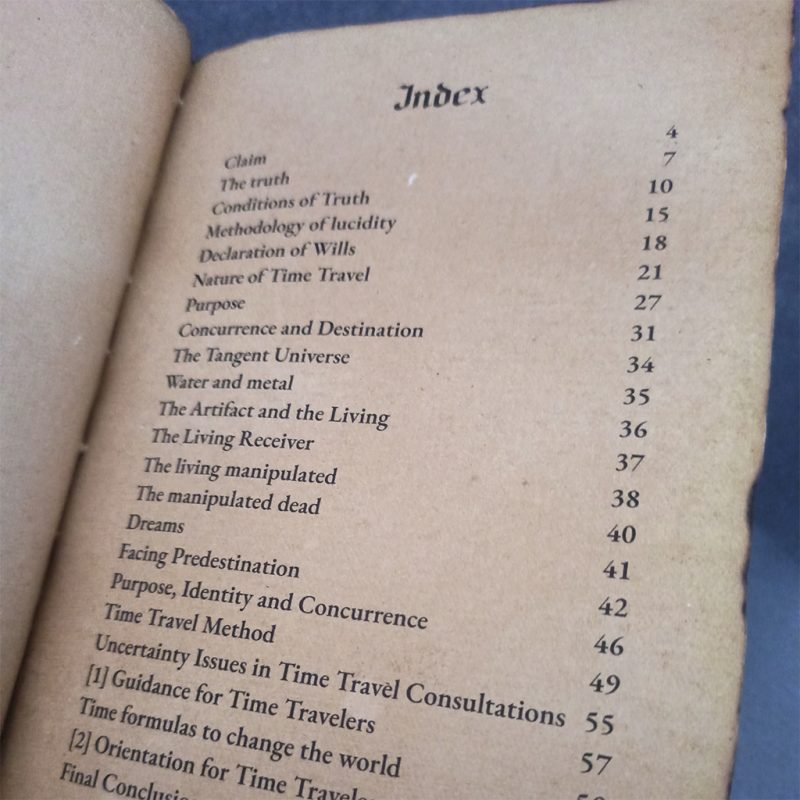
Reading for chrononauts · Limited edition
Philosophy can also cross time
A handmade work that explores the temporary traveler ethics, the concurrence of timelines, destiny and an introspective method to explore one's own history.
- Philosophy and moral standards for time travelers
- Tangent universes, causality, purpose and identity
- Illustrated and handcrafted A5 format
The file, availability and purchase are managed in Verbalus Mater.