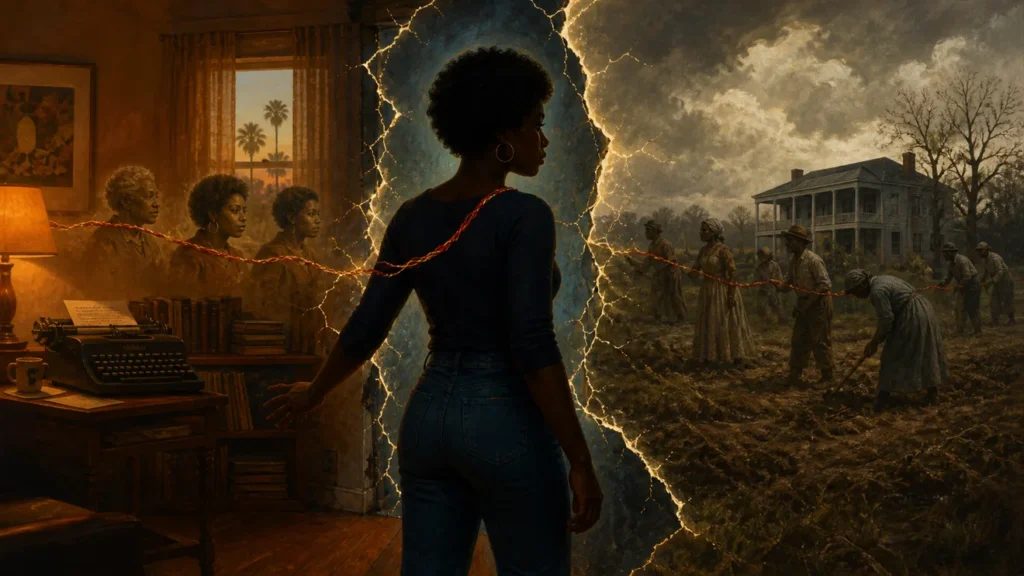
In Kinship (Kindred), traveling to the past does not allow us to contemplate history from a safe distance. Octavia E. Butler forces Dana, an African-American writer in 1976, to physically enter slavery in antebellum Maryland. Each displacement reduces the separation between archive and experience: the past stops being a date and becomes a system of power capable of hurting, transforming and demanding obedience.
Published in 1979, the novel uses a deliberately unexplained fantasy device. There is no machine, laboratory or equation. Dana disappears when a white ancestor is in danger and returns when her own life seems threatened. The simplicity of the rule focuses attention on a more important question: What does it mean to discover that our existence depends on people, violence and decisions that we cannot morally accept?
The premise: a call from family history
Dana Franklin lives with Kevin, her husband, in California. In 1976, on her birthday, she is swept without warning into a river in 19th century Maryland. There he saves Rufus Weylin, a white boy, from drowning. Seconds later, fear for her own life brings her home.
The jumps are repeated. Rufus seems to attract her whenever he is in danger. Dana discovers that he belongs to her family tree and that his survival is necessary for Hagar, an ancestor of Dana, to be born. The apparent mission is to protect him until the family line is secured. The dilemma is that Rufus grows up on a slave plantation and learns to exercise the authority that his society grants him.
This structure inverts the usual fantasy of the all-powerful traveler. Dana has education, historical memory, and some information about the future, but she arrives without material resources into a system that defines her body as property. Its knowledge does not annul power relations.
The rules of time travel in Kindred
Butler offers little explanation, but the regularities are clear:
- Rufus activates the trip when he believes his life is in danger. Dana appears near him, although she does not control the exact date or location.
- The return depends on Dana's danger. Extreme fear and the threat of death seem to lead the way to 1976.
- Time passes unevenly. A brief absence in the present may contain days or months in the past.
- Objects and other people can cross. The clothes, supplies and Kevin show that the phenomenon does not only affect consciousness.
- The wounds cross the temporal border. Returning does not restore the body.
- Family history seems stable. Dana does not travel to create her genealogy deliberately, but because she is already a part of it.
The model approaches a single line with closed causality. Dana knows that Hagar existed; therefore, Rufus must survive long enough to become his father. His interventions do not replace one known story with another: they are probably part of the story that led to his birth.
The genealogical paradox: protecting those who perpetuate harm
The central tension looks like the grandfather paradox, but it takes an ethical form. If Dana allows Rufus to die before fathering Hagar, she could erase her own existence. If you save him, you protect a man who uses slavery and coercion to control Alice, the black woman from whom Dana is also descended.
The novel does not treat genealogy as a mathematical curiosity. It turns it into a moral trap. Dana cannot imagine her origin as a clean chain of free choices. Their survival is linked to a relationship built under extreme inequality.
This raises a question that goes beyond science fiction: Does recognizing that we inherit a history mean justifying it? Butler says no. Dana can understand the conditions that gave rise to her family without absolving those who committed violence. Responsible memory does not need to transform ancestors into heroes.
Why doesn't Butler explain the machine?
The absence of scientific explanation is an aesthetic and political decision. A machine could turn the problem into a technological adventure: who built it, how it obtains energy or how to return. Butler eliminates that distraction. The mechanism is a link between Dana and Rufus, between present and genealogy.
From known physics, there is no process that spontaneously transports a person to the past because an ancestor is in danger. The theoretical proposals that include Wormholes o closed time curves They require radically different geometries and conditions. Kindred It belongs to social speculative fiction: the coherence that matters is thematic and causal, not engineering.
The emotional rule—danger to go, danger to return—turns each jump into a crisis. Dana can never use the past as a tourist destination. You also can't leave a scene whenever you want. Its lack of control reproduces the lack of autonomy that the historical system tries to impose on it.
The unequal time and distance between Dana and Kevin
When Kevin accidentally crosses paths with Dana, they both try to survive in a society that interprets their interracial marriage through violent categories. Kevin can move with a freedom that Dana does not possess. Even when he disapproves of slavery, his environment assigns him authority over it.
In one of the returns, Dana returns without Kevin and he remains years in the past. Much less time passes for her. The separation shows that time travel doesn't just affect calendars: it creates incompatible historical experiences within a couple. Kevin has aged and has experienced events that Dana does not share. Dana, in turn, has endured dangers he cannot fully understand.
Real relativity also allows two clocks to accumulate different durations, as you can see in the time dilation calculator. But in the novel the difference does not arise from speed or gravity. It is a property of the fantastic link between eras. Its function is to make visible how history distributes time unequally: for some it can be a closed past; for others it remains a present inheritance.
Modern knowledge does not equal power
Dana can read, knows the back story, and has basic medical knowledge. In another kind of story, these advantages could allow him to dominate the era. Butler avoids that fantasy. Information is only useful if there is freedom to apply it, resources to sustain it, and an audience willing to accept it.
On the plantation, an enslaved person's literacy is perceived as a threat. Healing someone can raise suspicion. Revealing too much about the future does not automatically destroy institutions. Power is maintained not because no one has imagined alternatives, but through laws, economics, violence and social habits.
This is a valuable lesson for any temporal history: a traveler does not arrive outside the power structures. Your knowledge of the future does not grant you money, documents, trust or protection. A good narrative must ask what real capacity for action it has in the place where it lands.
Adaptation as a survival mechanism
Dana learns to anticipate orders, measure words, and evaluate risks. From the outside, some behaviors may look like acceptance. The novel shows that adapting to a threat does not mean approving of it. People develop strategies to survive within a narrow range.
Butler also avoids a false opposition between absolute heroism and passivity. Resisting can mean teaching reading, maintaining family ties, sharing information, escaping, or simply staying alive. Each gesture has a different cost.
Dana fears that habituation will transform her identity. The longer you stay, the more normal certain routines may seem to you. That fear is central: the horror of a system does not reside only in exceptional acts, but in its ability to turn domination into everyday life.
Rufus: affection, dependence and power
Dana meets Rufus as a child and believes she can influence him. Sometimes it shows affection, vulnerability or need. It would be comfortable to present him as a monster without nuance, but Butler analyzes how a person capable of caring can use a monstrous institution when it protects his desires.
The relationship between the two is contaminated by mutual dependence. Rufus needs Dana to save him; Dana needs him to survive to preserve her genealogy. She tries to educate him morally, but he knows that he can resort to the power that the law grants him.
The complexity of the character does not reduce his responsibility. On the contrary: it shows that systemic cruelty does not require individuals incapable of affection. It requires that your affections become a possession and that the environment legitimizes that possession.
Alice and the limit of intervention
Alice is essential to understanding Dana's dilemma. She is not simply an ancestor necessary to complete a family tree. He is a person subject to decisions that others justify through Dana's future survival.
Dana tries to mediate, reduce damage and keep Rufus under some influence. But mediation can inadvertently make her part of the mechanism that puts pressure on Alice. Butler forces the reader to examine the gray area between helping someone within a system and helping to keep that system functioning.
There is no clean solution because Dana has no clean power. Their decisions are conditioned by immediate threats and by the knowledge of a future that depends on tragedy. The novel does not ask to judge it from an abstract security; asks to understand the type of choices that oppression produces.
Writing, reading and who controls the story
Dana and Kevin are writers. The profession matters because Kindred asks who has the right to narrate the past. Historical documents often preserve the words of owners, laws, and administrators; Many experiences of enslaved people appear fragmented or mediated.
When teaching reading, Dana doesn't just pass on a skill. It opens a path towards autonomy and memory, precisely why it is persecuted. The control of literacy reveals that power fears the ability to name one's own experience.
The novel adopts elements of slavery narratives and combines them with science fiction. The journey offers a contemporary protagonist a double position: she knows the language of the present, but her body is read by the society of the past under its racial categories. This double consciousness helps the modern reader to recognize both the historical distance and the continuity of its effects.
The body as an archive of the journey
In many temporary adventures, the protagonist returns and the wounds become anecdotes. In Kindred, the body preserves history. Scars, exhaustion and loss don't go away when you go back to 1976.
The denouement takes this idea to its most visible form: Dana loses an arm in the final transition, trapped symbolically and physically in Rufus' house. The image expresses that no one enters a story of violence and comes out completely separated from it. The past is not “behind”; It is part of the present body.
The loss also prevents us from interpreting the ending as a simple victory. Dana survives and breaks Rufus' immediate control, but pays an irreversible price. Freedom does not restore what the system destroyed.
Analysis of the end
When Rufus tries to impose on Dana a relationship that reproduces his possession of Alice, she understands that the dependency has reached a limit. He kills him to defend himself and manages to return. The family line is now secured because Hagar has been born.
From a temporal point of view, the sequence closes the circuit. Dana was always descended from Hagar and her travels were probably always integrated into the story. From a moral point of view, closure occurs when she stops considering Rufus' preservation an obligation higher than her own autonomy.
Dana and Kevin then travel to contemporary Maryland to search for records. They find silences and fragments. Direct experience does not eliminate the documentary problem: they know more than the archives can demonstrate. This difference between memory and record summarizes the novel. The history lived is extensive; the preserved history may be an incomplete line.
Is there a bootstrap paradox?
A bootstrap paradox appears when an object or information exists in a loop with no identifiable origin. Kindred It contains circular causality, but it does not need an authorless object. Dana saves Rufus because she is descended from him; Its future existence motivates actions that allow it to preserve its existence.
we can call it self-consistent genealogical loop. The cause of the voyages remains mysterious, but the information and people retain recognizable origins. The biggest enigma is not logical, but selective: why does this link activate the phenomenon and why does it use danger as a trigger? Butler leaves the question open because answering it would not necessarily improve the core of the book.
Could Dana change history?
The novel never demonstrates that a second line exists. Everything indicates that his travels already belonged to the past from which he comes. This is close to the Novikov self-consistency: The actions of a traveler within a time curve must be compatible with the history that originated them.
However, Butler does not turn the characters into willless pieces. Dana makes real decisions within severe constraints. Self-consistency describes the overall result; it does not eliminate the experience of choosing, doubting or resisting.
This distinction also matters outside of fiction. Being conditioned by a structure does not mean lacking agency, but it does mean that options are not distributed equally. The novel makes this difference its true temporal problem.
Comparison to other time travel novels
Facing The time machine
H. G. Wells' The Traveler travels to a distant future and observes social evolution from an initially privileged position. Dana travels back in time and discovers that neutral observation is impossible. You can compare both approaches in our analysis of The time machine.
Facing Traveler's wife at the time
In both works the displacement is involuntary and the body is exposed. But Kindred links that vulnerability to history, race, and institutional power; he doesn't use her primarily as a romantic obstacle.
Facing 22/11/63
Jake travels with a conscious mission of historical transformation. Dana is summoned to preserve a genealogy that hurts her. One asks if we should change major events; the other, how to live knowing that the present contains an irreparable past.
What does it contribute? Kindred to the genre
- Turn history into bodily experience. The past is not information that is consulted.
- Limits the power of future knowledge. Knowing more is not enough when institutions control action.
- It unites genealogy and causality. The temporal paradox becomes a question about inheritance.
- Avoid easy heroism. Surviving requires incomplete decisions within unfair conditions.
- It makes continuity visible. The trip does not end when you return because the body and memory preserve its effects.
Reading guide to get the most out of the novel
As you read, it may be helpful to separate three lines:
- The historical chronology: growth of Rufus, changes in the plantation and birth of Hagar.
- Dana's personal time: how long you stay at each visit and what you learn.
- Kevin's time: especially during the separation that lasts for him for years.
It is also worth observing when Dana can speak, when she should remain silent, and who interprets her knowledge as a threat. If you want to visually represent those sequences, use the timeline builder and create a branch for each personal time.
Frequently asked questions about Kindred
Is it a science fiction novel?
Yes, although it does not technically explain the trip. It uses a speculative impossibility to examine history, identity, and power. Science fiction doesn't always need detailed engineering.
Why doesn't Dana change big events?
He does not control his arrivals and is under constant threat. Furthermore, her immediate objective is to survive and ensure the existence of her ancestor. The novel rejects the fantasy that an isolated person can dismantle an institution through future information.
Can Rufus be redeemed?
Dana tries to influence him, but affection is not enough to neutralize the power he decides to exercise. Understanding your training does not eliminate your responsibility.
What does losing your arm mean?
It materializes the union between eras. Dana returns free, but a part of her body is trapped in the place where Rufus was trying to hold her. The present carries a loss produced by the past.
Is it suitable for readers who don't usually read science fiction?
Yes. The mechanism is quickly understood and the novel focuses on characters, history and moral dilemmas. It is an especially powerful door into speculative fiction.
Conclusion: the past is not over
Kinship shows that a great temporal history does not depend on explaining a machine. Its strength comes from connecting causality with responsibility. Dana cannot choose the events that made her birth possible, but she can decide how to look at them and where her obligation to preserve them ends.
The journey reveals that chronological distance does not guarantee moral distance. Institutions formally disappear and, even so, they leave behind language, inequality, documentary silences and wounds. Remembering is not returning intact: it is allowing knowledge to change our relationship with the present.
Butler brings to the genre an idea that is difficult to forget: if we could touch the past, perhaps we would not find an adventure waiting to be corrected, but a network of people forced to survive within options that were never equivalent. Understanding this network does not solve the story, but it prevents treating it as an abstraction.
Reading for chrononauts · Limited edition
Philosophy can also cross time
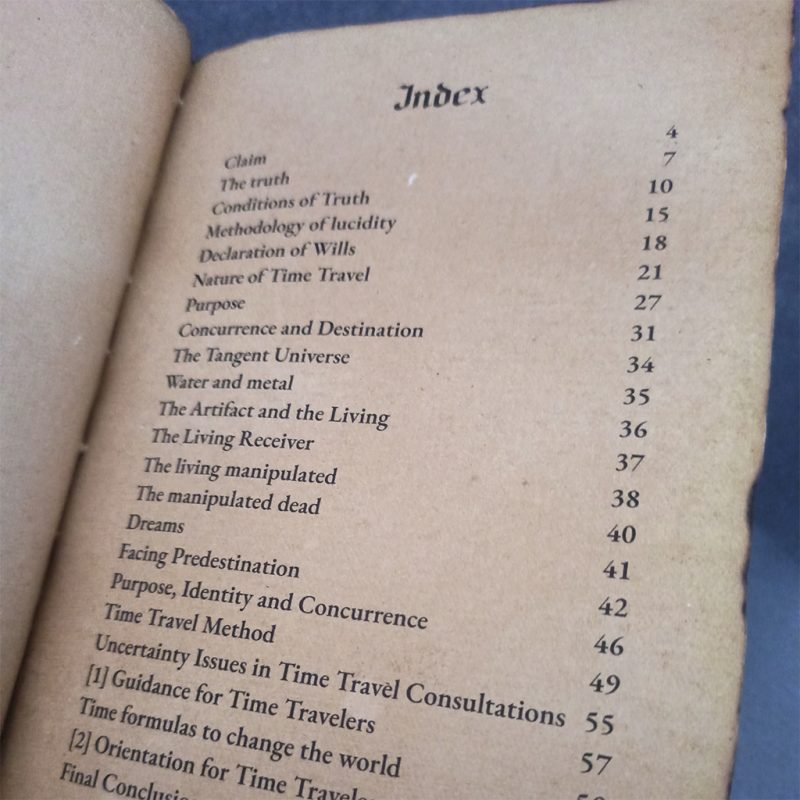
A handmade work that explores the temporary traveler ethics, the concurrence of timelines, destiny and an introspective method to explore one's own history.
- Philosophy and moral standards for time travelers
- Tangent universes, causality, purpose and identity
- Illustrated and handcrafted A5 format
The file, availability and purchase are managed in Verbalus Mater.