Before TikTok, VHS-style videos and headlines designed to go viral, the internet already had its own visitors from the future. They entered small forums, answered questions for weeks and left stories that mixed technology, catastrophes, paradoxes and moral warnings. Some of those publications disappeared; others were copied so many times that today it is difficult to separate the original message from its reinterpretations.
This article reconstructs the most influential messages attributed to alleged time travelers, but it does not assume that its authors told the truth. The useful question is not only "were they real travelers?", but also: What exactly did they claim, what could be proven, what happened next and why are we still talking about them?
Why a supposed traveler's messages are so convincing
An extraordinary message does not become credible just by including a future date. Stories that last usually combine four elements: a technical detail that is difficult to assess, an incomplete biography, a recognizable threat, and an exit that protects the story when a prediction fails. The result looks less like an isolated prophecy and more like a interactive storytelling built with the help of the audience.
The forums were the perfect environment. Each question allowed the supposed traveler to expand his world: how does the machine work? What currency is used? What books survive? What does someone feel when they learn about their own past? Readers weren't just consuming a story; They participated in its development. This mechanism explains why some cases retain an active community decades later.
John Titor: the file that defined the internet time traveler
The most influential case began on November 2, 2000, when a user named TimeTravel_0 posted on the Time Travel Institute forum. He later adopted the name John Titor and moved part of the conversation to the Post2Post board related to the Art Bell show. His interventions continued until March 2001.
Titor's importance lies not in the fact that he demonstrated his story - he did not - but in the density of the material: answers, photographs, diagrams, predictions and preserved discussions. He original materials archive allows you to compare the source with later versions. This comparison is essential because numerous summaries attribute phrases to Titor that were reformulated or added by third parties.
Message 1: a mission in 1975 to recover an IBM 5100
Titor claimed to be a soldier born in 1998 and stationed in 2036. His mission was to travel to 1975 to obtain a IBM 5100 computer, required to work with legacy computer systems. In his account, the team possessed emulation capabilities that were not known to most of the public.
This detail became the most cited piece in favor of history. However, the conclusion must be formulated carefully: just because a piece of information was little known does not mean that it was inaccessible. There were manuals, technicians, collectors and specialized documentation. Rare knowledge proves rare knowledge; it does not prove time travel by itself.
The choice of the IBM 5100 is also narratively effective. It turns a real and verifiable device into the object of a future mission. Instead of asking us to believe only in an impossible machine, the story relies on historical technology that we can observe.
Message 2: The C204 device and Kerr black holes
The alleged traveler described a "temporary displacement" unit installed in a vehicle. His explanation resorted to two rotating singularities, gravitational fields and a reference to the Kerr black holes. He also shared diagrams and photographs of what he presented as technical documentation.
Physics uses mathematical solutions associated with black holes in the study of space-time, but between a solution of the equations and a transportable machine there is a chasm. There was a lack of data that would allow the mechanism to be reproduced: energies, materials, exact geometry, control of instabilities and an experimental procedure. You can expand this context in our guide on Wormholes.
The lesson is important: Using scientific vocabulary is not equivalent to offering a scientific theory. A verifiable proposal must allow results to be calculated and tested, not just sound compatible with real concepts.
Message 3: a divergence between timelines
Titor claimed that his world and ours were not identical. He spoke of a small divergence between timelines, so that the events of his past did not have to repeat exactly in our future. This idea absorbed an inevitable objection: if a prediction failed, it could be attributed to the difference between worlds.
The many-worlds interpretation of quantum mechanics is a serious proposition within physics, but does not prove that a person can select a branch, travel to it, and return. In Titor's story, the concept also functions as a protective narrative mechanism. Read our introduction to parallel universes to distinguish physical interpretation from its use in fiction.
Message 4: civil war, global conflict and a rural society
Among its most concrete statements were civil unrest in the United States beginning in 2004, an open war around 2008, and a nuclear conflict in 2015. It also described a less globalized future, with rural communities, weakened institutions, and daily life marked by survival.
Those forecasts were not met on the dates or in the manner announced. The Olympic Games continued after 2004 and the war sequence described did not occur. When a prediction has a date, place and result, moving it back a few years to accommodate later events destroys its probative power.
That doesn't make the message irrelevant. It shows how a futuristic story feeds on the fears of its present. In the late 1990s and early 2000s, there were concerns about the Y2K effect, information fragility, political polarization, and technological dependency. Titor's future also seems to be a mirror of the anxiety of his time.
Message 5: simple tips to survive the future
The most remembered messages were not always the most technical. Titor recommended learning first aid, taking care of your health, growing food, valuing your family and distrusting overly centralized structures. They are reasonable advice in many scenarios and that is why they age better than failed dates.
Here appears a common technique in prophetic stories: combining risky statements with general recommendations. If the predictions fail, the advice still seems sensible and maintains the impression of wisdom. It is advisable to evaluate both types of content separately.
Single Seven: the antecedent that already contained the formula
Before the name John Titor dominated the conversation, other users of anomaly forums introduced themselves as temporary visitors. Among the most cited is Single Seven, associated with publications from the late nineties. The story included a future society, restrictions on what could be revealed, and answers to questions from participants.
The interest of the case does not depend on accepting its authenticity. Single Seven helps to see that the formula was already available: opaque identity, selective knowledge, rules that prevent delivering a decisive proof, and a community that fills in the gaps. The similarities do not prove that the authors were the same, but they do indicate that John Titor did not appear in a cultural vacuum.
Furthermore, the more fragmentary an archive is, the easier it is to reconstruct it according to current expectations. A screenshot without a URL, verifiable date, or context can be authentic, modified, or entirely later. That is why, in digital research, provenance matters as much as content.
Andrew Carlssin: when a satirical news story becomes a “document”
Another recurring name is Andrew Carlssin, an alleged investor who would have turned a small sum into a fortune through perfect stock market operations and who, when arrested, would have confessed to being from the future. The story is usually presented as deleted or silenced news.
The problem is that its origin is linked to Weekly World News, a publication known for fictional and sensational stories. The republications gradually eliminated the humorous context until transforming the piece into an apparent journalistic chronicle. We are not facing a chain of messages from a traveler, but rather an example of loss of context by copy.
This case offers a very useful rule: when a story says "the media deleted it," look for the oldest publication available. Often a test did not disappear; The label explaining that it was satire disappeared.
The viral travelers of YouTube and TikTok: predictions designed after the event
With social video the format changed. Characters with generic names - "Noah", "the man from 2028" or accounts that say they are trapped in an empty city - show blurry objects, supposed future news or deserted places. The montage replaces the long exchange on the forums.
Many of these accounts function as serialized entertainment: posting clues, responding to followers, and continually delaying the ultimate test. Some use deletion, off-peak hours, editing, filters, controlled scenarios, or digitally generated pieces. The platform incentive rewards the continuity of the mystery, not its resolution.
A prediction only counts if it was public, specific, dated before the event and preserved against modification. A re-edited video, a comment without an archive, or a broad phrase like “there will be a big crisis” do not meet these requirements. The more events that are mentioned, the more likely it is that some of them seem right by chance.
The scientific experiment that searched for travelers on the internet
In 2013, researchers Robert Nemiroff and Teresa Wilson proposed an ingenious search: locating advance references on the Internet to information that did not yet exist publicly. They examined terms related to subsequent events, queries to astronomical services, and requests for a potential traveler to send a message dated before the call.
The work, titled Searching the Internet for Evidence of Time Travelers, found no evidence of visitors from the future. The authors correctly explained the scope of the result: a negative result does not prove that time travel is impossible, but it does indicate that the type of fingerprint searched for did not appear.
This experiment is valuable because it transforms a fantastic question into observable criteria. It doesn't ask whether a story "seems" authentic; define in advance what evidence would count as success.
The seven patterns that repeat in messages
- Inaccessible authority: The narrator belongs to an army, laboratory or future institution that is impossible to consult.
- Technical detail without reproducibility: Models, diagrams or scientific terms appear, but the information necessary to repeat the supposed phenomenon is missing.
- Elastic predictions: Wide ranges, symbols or probable events are used that allow for many interpretations.
- An explanation for the error: temporal divergences, changes caused by the message itself or prohibitions on revealing too much.
- Test always postponed: the definitive object will arrive later, has been lost or would put the traveler in danger.
- Community participation: Audience questions provide insights, correct inconsistencies, and expand the story.
- Moral warning: the catastrophic future turns the narrator into a messenger and gives the story emotional finality.
How to verify a supposed message from the future
1. Find the oldest source
Don't start with a video that summarizes another video. Find the original message, thread, or file. Check the URL, date, contemporary replies, and whether the site allows you to edit posts without leaving a trace. A web file provides more context than an isolated capture.
2. Separate statements before evaluating them
Divide the story into units: identity, physical mechanism, dates, events, documents and photographs. A correct statement does not automatically validate all others. The data about an ancient computer does not prove a future war; An authentic photograph of an object does not demonstrate the function attributed to the object.
3. Record predictions before knowing the result
Create a table with the exact text, deadline, degree of precision and fulfillment criteria. Avoid rewriting the prediction later. If "a big political change" retrospectively turns into any contentious election, the prediction was not falsifiable.
4. Look for knowledge available at the time
A little-known detail may come from manuals, magazines, technical groups, previous fiction, or professional experience. The correct question is not "did the general public know?" but "Could anyone know at that time?".
5. Demand a test that can fail
A strong test must have a result that can show that the claim was incorrect. Dates protected by infinite timelines or photographs without chain of custody do not meet that condition. You can delve deeper into this problem by reading about chronology and causality.
6. Do not confuse absence of explanation with evidence
The fact that we do not yet know the author of a message does not make the author a time traveler. Between "demonstrated fraud" and "demonstrated journey" there is a wide territory: narrative game, literary experiment, joke, marketing, collective identity or incomplete archive.
What value do these stories have if they are not evidence?
The stories of supposed travelers function as cultural laboratories. John Titor asked, in legend, what would happen if the future could not change our present because each trip opened another branch. Current videos ask how much we trust an image when its technical production is invisible. Andrew Carlssin shows how a joke loses its label in circulation.
They also reveal something about our relationship with time: we want a warning that turns uncertainty into a story. A future with dates, culprits and rules may be more bearable than an open future. That's why The best analysis must preserve astonishment without giving up the method.
The authentic evidence of time displacement that we have is much less cinematic: clocks that accumulate differences due to speed or gravity, unstable particles whose life span is extended, and navigation systems that correct relativistic effects. The time dilation is measured; messages from visitors from the future, no.
Frequently asked questions about alleged internet travelers
Did John Titor get any predictions right?
Some readers relate Titor's general phrases to later events, but his more concrete and dated predictions—the American civil war, the 2015 nuclear conflict, and the end of the Olympic Games after 2004—did not come true. The knowledge about the IBM 5100 is interesting, although it was not necessarily information from the future. There is no exclusive, unequivocal and documented success that forces you to accept your identity.
Could an alternate timeline explain the errors?
As a narrative possibility, yes: if each trip led to a different story, a visitor could remember events that will never happen here. As a verification method, it is useless, because it makes all possible results compatible with history. A hypothesis that explains both success and error without ever changing does not allow us to distinguish between a traveler and someone who improvises.
Can a screenshot prove that the message is old?
Not by itself. The image may have been cropped, modified or generated afterward. It is preferable to have an archived copy with URLs, contemporaneous responses, and separate timestamps. Even then it is shown that the content was published on a date, not that its author came from the future.
What evidence would be truly convincing?
A strong combination would include very specific future information recorded in an unalterable form, several improbable hits without a long list of misses, reproducible technical data, and an object or phenomenon subjected to independent teams. The more extraordinary the claim, the more important it is that the evidence can be examined by people who are not dependent on the narrator.
Conclusion: read the future with curiosity and judgment
The main messages from the supposed network of time travelers speak of wars, impossible machines, ancient computers, divergent worlds and societies that must relearn how to survive. However, when we apply verifiable criteria, none provides a public demonstration of travel to the past.
This does not require them to be discarded. We can read them as digital folklore, collaborative science fiction, and food for thought about physics, causality, and misinformation. The key is to maintain two ideas at the same time: A story can be fascinating without being true, and a question can be valuable even if its answer is negative.
Reading for chrononauts · Limited edition
Philosophy can also cross time
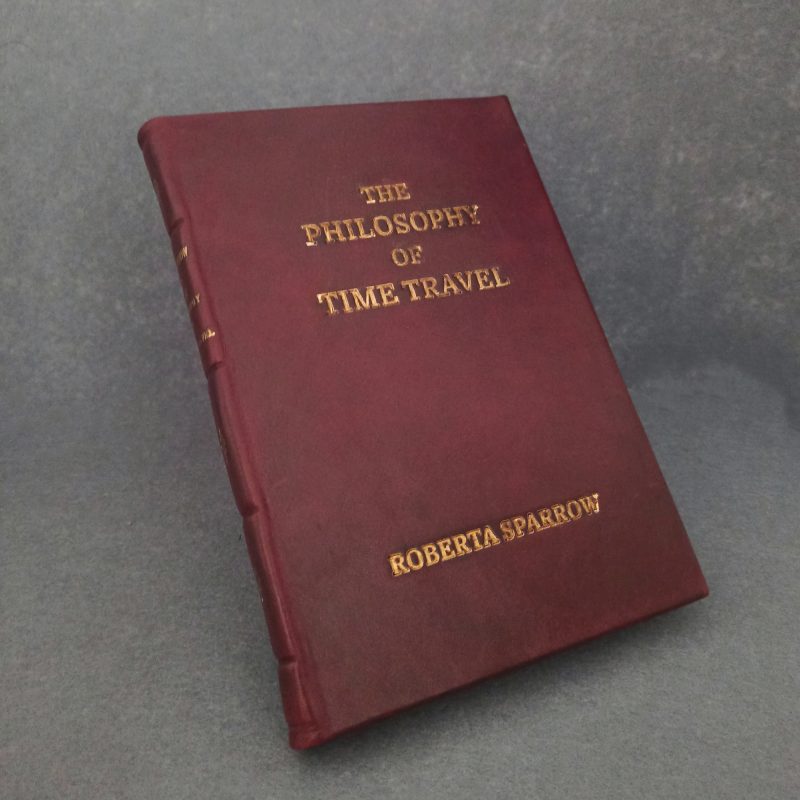
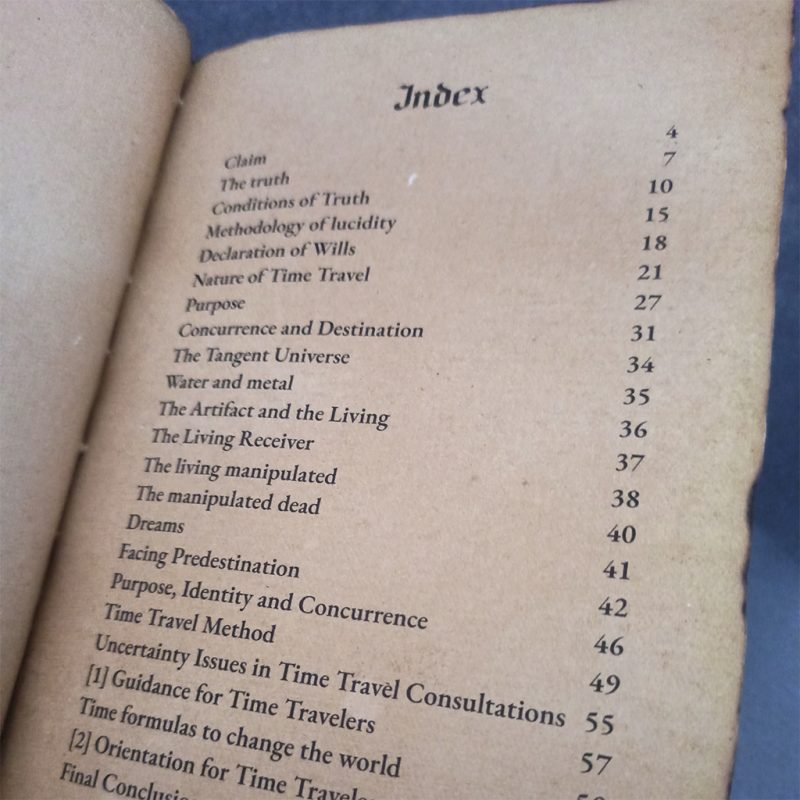
A handmade work that explores the temporary traveler ethics, the concurrence of timelines, destiny and an introspective method to explore one's own history.
- Philosophy and moral standards for time travelers
- Tangent universes, causality, purpose and identity
- Illustrated and handcrafted A5 format
The file, availability and purchase are managed in Verbalus Mater.