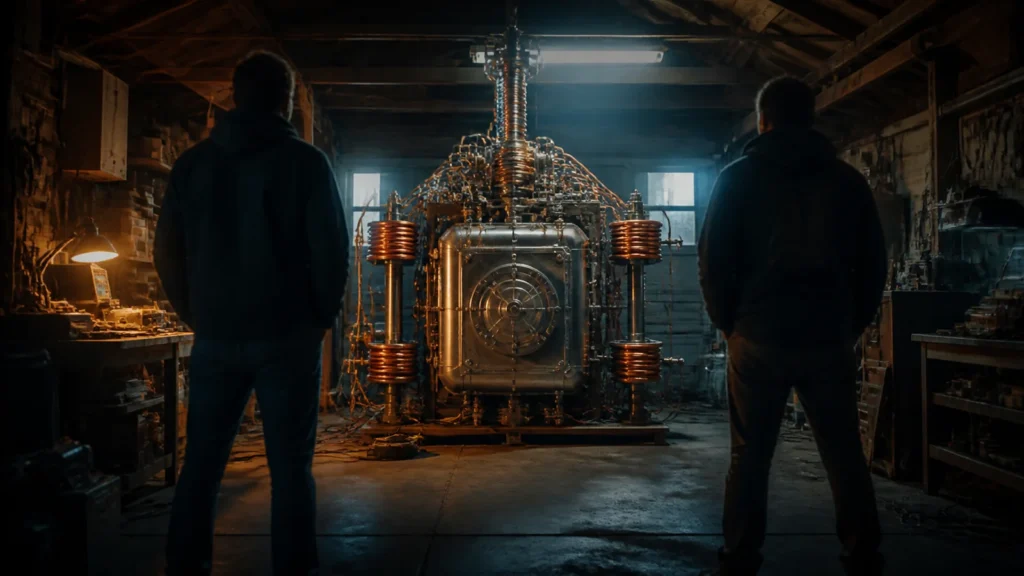
First (2004) is probably the film that is most like finding a time machine in the real world: it arrives not accompanied by fanfare, but by strange measurements, electrical noise, notebooks full of data and two engineers who take a long time to understand what they have built. Shane Carruth turns that sobriety into his main narrative resource. The film does not only ask how to return to the past; asks what happens when two people who are technically brilliant but emotionally unable to trust each other gain an advantage that no one can audit.
This analysis contains spoilers completos. We're going to reconstruct the plot, explain how the boxes work, order Abe and Aaron's prints, and separate the physics suggested by the film from its licenses. To locate the concepts, it is advisable to first consult our guide on the science of time travel and the explanation of the closed time type curves.
From a garage experiment to a temporal anomaly
Aaron, Abe, Robert and Phillip are engineers who dedicate their free time to projects capable of attracting investment. While testing a device to apparently reduce the weight of an object using an electromagnetic field, Abe detects impossible results: the material accumulates more time than it has passed in the laboratory. The film's first important decision is not to present the phenomenon as an instant jump. Within the field, the object travels a temporal trajectory that alternates directions until it emerges older than expected.
Abe expands the device until he builds a box that can fit one person. Discover an operational rule: if the machine turns on at 8:00, a traveler can enter at 2:00 p.m., stay inside for six hours, and leave at 8:00 a.m. To go back six hours you have to endure six hours of travel. The box does not carry any date; It only allows you to go back to the moment it was activated. This limitation makes the mechanism much more interesting than an arbitrary portal, because it forces you to prepare the past before knowing if you will need to visit it.
How the Primer box works
Let's imagine a line between A, the moment of ignition, and B, the moment in which the traveler enters. The machine creates a region where the object temporarily oscillates between both extremes. After a sufficient number of runs, he can abandon the box near A. From the outside perspective, a second version of the traveler appears while the original version is still heading towards B. That's why Abe and Aaron isolate themselves in a hotel: they need to avoid their doubles and ensure that the version that will reach the box repeats exactly the planned actions.
The film suggests that the field has two equilibrium states and that matter takes time to abandon one to adopt the other. The language is reminiscent of real physical transitions, but does not constitute a complete theory. We are not aware of any electromagnetic device capable of reversing the macroscopic temporal orientation of a body. What is plausible is the methodology: calibrate, observe contamination, repeat measurements and distrust the spectacular results. What is fictitious is that this process leads to a closed and stable temporal region.
Abe's first controlled trip
Abe builds the first human box without telling Aaron. He activates the device, goes to a hotel to stay out of the way, returns hours later, enters and emerges in the morning. He then appears before Aaron and demonstrates his success by predicting the day's events. At that moment there are two Abes: the one that came out of the box and the original that will still make the trip. The test seems controlled because both versions follow the same itinerary and do not meet.
Abe believes he has designed a safe discipline: short windows, isolation and minimal changes. But sharing the secret destroys that prudence. The two friends use the boxes to find out the behavior of the bag. Its initial objective is not to correct tragedies, but to obtain capital without attracting attention. The financial advantage is a demonstration of the problem of information without origin: knowledge of a quote comes from the future, but its use alters the context that allowed it to be obtained.
The party, Thomas Granger and the breaking of protocol
The chronology becomes complicated when Aaron decides to intervene at a party where an armed man causes a tragedy. He repeats the day several times, records the conversations and rehearses his performance until he becomes a hero. He no longer observes a future to reproduce it; manipulates people using previous versions as a draft. Time travel transforms into narrative editing and Aaron goes from engineer to director of a reality that only he remembers complete.
The appearance of Thomas Granger, father of Abe's partner, confirms that someone else has used a box. Granger appears in a comatose state and her trip has no clear explanation. What is important is the effect: Abe understands that the system is no longer under control. If Granger knew about technology in a possible future and used a box, then Abe and Aaron's actions may be receiving consequences from lines they have not yet consciously experienced.
The Emergency Box and Aaron's True Advantage
Abe had prepared a safe deposit box long before: a machine turned on and hidden that would allow him to return to the beginning of the experiment if everything went wrong. His ultimate plan is to use it, prevent his previous version from building the machine, and erase the chain of abuse. However, Aaron had already discovered that box. He used it before, bringing another folded machine with him and replacing Abe's device. He also drugged and hid one of his own versions.
This explains the feeling that we are always late. The Aaron we follow during part of the story is not the first. He has recordings and knowledge of previous iterations. Abe thinks he's revealing time travel to a friend who doesn't know him yet, when he's actually talking to a version that has already rearranged the board. Information asymmetry, not the power of the machine, decides who dominates.
How many versions are there
There is no completely certain count because the film deliberately conceals trips. At a minimum we must distinguish the original Abe, the Abe who performs the demonstration, and the Abe who uses the emergency box; plus an original Aaron, an Aaron who has performed iterations of the party, and another who has taken control of the safe. Some versions remain unconscious and others continue to live in branches that the narrative abandons.
The best way to understand it is not to number each copy, but to follow three questions: What box did you use? What information do you retain and what version is out of circulation? Two identical bodies are not narratively equivalent. Each one has different memories and, therefore, a different set of incentives. Primer converts identity into a history of information.
A single timeline or multiple branches?
The film does not formalize a cosmological model. Sometimes it seems that changes overwrite a single story; At other times, the displaced versions continue to exist, which fits better with branching. The simultaneous presence of duplicates shows that the universe does not automatically eliminate the previous traveler. However, the narrative follows a specific experience and leaves other trajectories off-screen.
A branching model avoids some of the the grandfather paradox: preventing an action does not erase the traveler, because it comes from another story. But it creates a moral cost. The abandoned lines still contain people who suffer the consequences. Aaron treats the failed iterations as disposable rehearsals, although from within each one their inhabitants are as real as he is.
The bootstrap paradox of information
When Aaron listens to a recording to repeat a conversation exactly, part of his behavior is no longer born of a spontaneous decision. The recording exists because an earlier version spoke; the new version talks like that because it listens to the recording. If the cycle stabilized completely, the words might lack an original author. This is a way of bootstrap paradox, where information or objects circulate in a causal loop.
Primer avoids a perfectly clean loop through imperfections: fatigue, errors, bleeds, degraded writing, and diverging decisions. The body retains the cost of travel. Reality can repeat itself, but the traveler does not return to an initial state. That buildup breaks the fantasy of a free reboot.
Entropy, causality and the biological price
In macroscopic physics, the arrow of time is linked to the increase in entropy. Primer's box does not show a body disassembling or heat flowing backwards; the traveler thinks, breathes and ages while receding from the outside. This implies a bubble with its own temporal orientation, protected from the environment. Maintaining that separation would require extreme conditions that the film does not explain.
The side effects—bleeding, coordination problems, and impaired handwriting—serve as a reminder that the body is not passive baggage. A brain depends on electrical signals, chemistry, temperature and timing. Although the film does not offer a medical mechanism, it is correct in presenting temporary exposure as a systemic aggression, not as a stroll without consequences.
Primer versus Novikov consistency
The consistency conjecture It proposes, in a simplified way, that events within a time curve must be compatible with the history that already contains them. If Primer obeyed strict consistency, Abe would not be able to erase the invention: his attempts would be part of the causes that led to its construction.
The film seems to allow for modifications and duplications, thus distancing itself from Novikov. But it retains a similar intuition: the more they try to control the past, the denser the network of conditions they must maintain becomes. The result is not absolute freedom, but dependence on hotels, alarms, recordings, sedated doubles and already activated boxes.
The end: separation and expansion
Abe decides to stay close to his doubles to prevent further trips. Aaron goes abroad and begins to build a huge box. They are two responses to the same discovery. Abe seeks containment; Aaron, escalated. Neither can return to the previous friendship because both have evidence that the other is willing to manipulate them.
The final big box can be interpreted as an attempt to transport many people, large objects or to expand the time window. It also represents an ambition that no longer needs justification. Aaron doesn't want to correct a specific accident: he wants to have his own temporary territory.
Why Primer is still a reference
Its difficulty does not come only from having many lines. It comes from the fact that the film denies us the privileged point of view that normally dictates a story. We hear half-hearted conversations, see consequences before plans, and follow characters who withhold information even when alone. The form imitates the theme: the viewer also receives data without knowing which iteration it comes from.
The film also understands that a revolutionary technology can be born in a mediocre space. The garage, warehouse, and hotel are more disturbing than a government laboratory because they eliminate institutional barriers. Nobody reviews the ethical protocol. Nobody forces you to document the copies. The machine works before its inventors have asked an adequate moral question.
Frequently asked questions
Would Primer's machine be physically possible?
Not with known physics and technology. General relativity admits geometries with closed time paths, but producing and stabilizing them would require very different conditions than a garage electromagnetic field. The film uses scientific vocabulary to build internal coherence, not a reproducible blueprint.
Why do they have to wait inside the box?
Because the backward movement occurs at the same speed with which external time advances. To leave six hours early, they must remain in the field for approximately six hours. This rule limits the distance and makes it essential to activate the machine in advance.
Do Abe and Aaron change the past?
Yes, at least from his experience. The party is repeated with different results and several versions coexist. The film does not decide whether the previous stories are overwritten or continue as branches, but the traveler retains memories of states that are no longer shared by others.
Conclusion
Primer is not a puzzle that is solved once and gone. It is a story about how knowledge alters relationships. Its boxes materialize the temptation to turn every decision into a draft, but each correction adds bodies, secrets and obligations. Time travel does not make Abe and Aaron freer: it locks them in an architecture of suspicion of their own construction.
Actual physics doesn't support its domestic machine, but the film asks a rigorous question: If we could repeat a few hours, would we still be responsible for the versions we left behind? In that question, more than in the diagrams, lies its precision.
Reading for chrononauts · Limited edition
Philosophy can also cross time
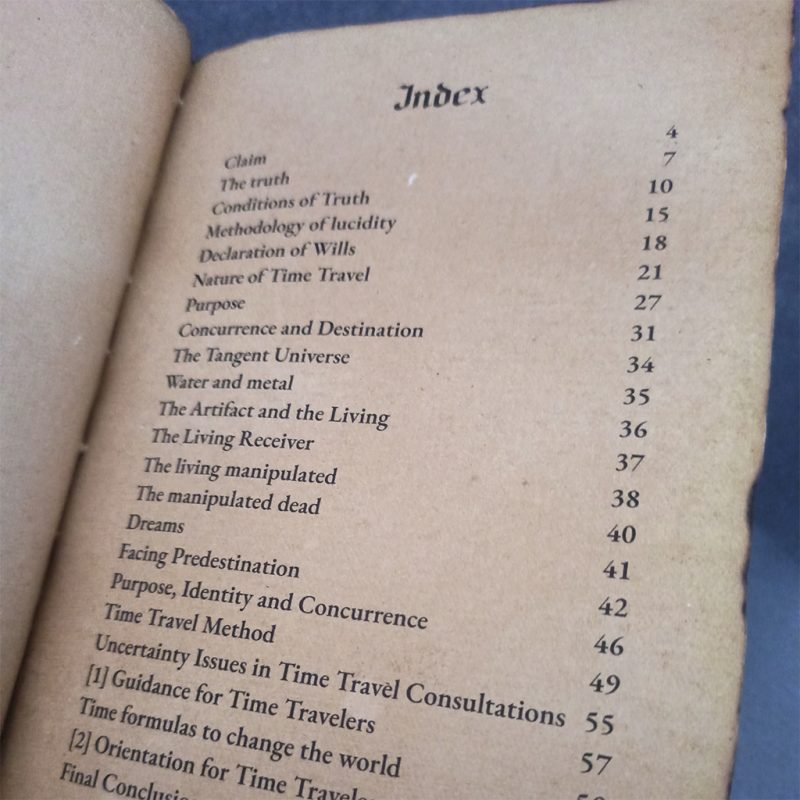
A handmade work that explores the temporary traveler ethics, the concurrence of timelines, destiny and an introspective method to explore one's own history.
- Philosophy and moral standards for time travelers
- Tangent universes, causality, purpose and identity
- Illustrated and handcrafted A5 format
The file, availability and purchase are managed in Verbalus Mater.