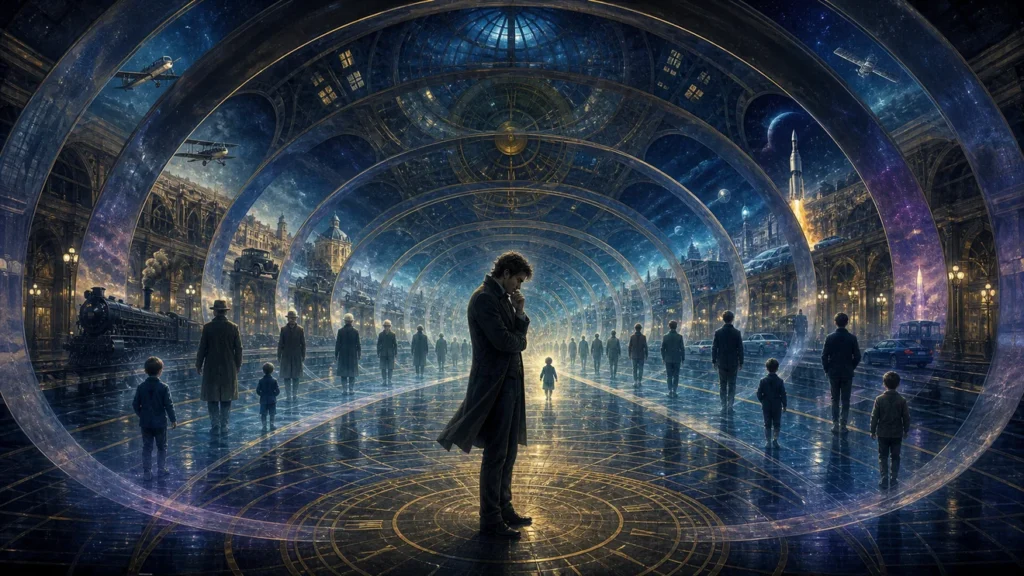
Harry August does not travel to a date: he is born again. Every time you die, your life begins anew in the same place and time, with the memory of all previous existences. You can study another profession, avoid a mistake, love another person, or dedicate decades to research. The world, however, goes through the 20th century again.
The first fifteen lives of Harry August, by Claire North, transforms reincarnation into a rigorous and emotionally disturbing temporal mechanism. Its protagonist belongs to a group of people who live in a loop. Information can travel backwards not through a machine, but by passing from one generation of repeaters to another. When a girl visits Harry on his deathbed and warns him that the end of the world is accelerating, repetition stops being a refuge and becomes responsibility.
The novel combines thriller, philosophy, alternative history and an intellectual duel between two men who remember too much. This analysis explains its temporal model, the paradoxes of information, the ethics of progress and the reasons why the book is of interest even to those who do not usually read science fiction.
What does it mean to live a circular life?
Harry is born into the same circumstances and travels through the same general era each time. When he dies, he returns to childhood. He does not occupy another body nor does a simultaneous copy appear: his consciousness returns to the beginning of his own biography and progressively preserves his memory.
These people are known as kalachakra u ouroboranos, terms associated with cycles. Not everyone remembers from the first moment of childhood. Adult consciousness emerges as the child brain develops, resulting in confusion, isolation, and in some cases extreme suffering.
Repetition offers obvious advantages. Harry can learn languages, sciences, and strategies to a depth impossible for a linear life. You can also invest, anticipate wars or avoid personal dangers. But each death erases the external results: only embodied knowledge crosses over to the next existence.
Harry August's Temporary Rules
The system can be summarized like this:
- Each repeater has a fixed birth point. Your loop covers your life, not the entire story.
- Death restarts existence. The cause of death may change, but the next destination is childhood.
- Memory goes through reset. Skills and memories can accumulate, even if the body has to relearn how to execute them.
- The other inhabitants do not remember. For most, each cycle is the only version of the world.
- Local changes are possible. A life can differ greatly from the previous one.
- Major alterations propagate to future generations. Accelerating one technology can advance others and move the end of the world.
- Information travels to the past by human relays. A young repeater tells something to an older one; This he communicates in his next life to someone born before, creating a reverse chain.
This last point is one of the most original ideas in the book. No individual can be reborn before his or her own birth, but a network of overlapping lives allows messages to be transported back to increasingly ancient times.
The Cronos Club: an institution outside of linear time
Repeaters create the Cronos Club to meet, protect children who remember too much, share resources and maintain some stability. An adult can wait for the birth of another member, explain what it is and make their life easier. In the next cycle, that member will return the favor to someone born earlier.
The organization solves practical problems. How does a child prove that he has lived seven times? How do you get documents or money? How do you find others without exposing yourself? The Club converts individual power into social infrastructure.
It also establishes a standard: not radically transform the development of the world. Its members can improve their lives, but they must avoid technological or political alterations that could destabilize subsequent generations. Prudence is born from centuries of accumulated experience.
However, that policy may seem comfortable. Those who remember can protect themselves while linear people repeat wars, poverty and disease. The novel does not present the Club as the undisputed owner of morality. Ask if preserving history is a responsibility or a privilege.
How a message travels backwards without a machine
Let's imagine three repeaters. Ana is born in 1900, Bruno in 1940 and Clara in 1980. Clara discovers in 2020 that a catastrophe will occur. When Bruno gets older, Clara tells him. Bruno died and was reborn in 1940, preserving the message. Years later he meets Ana, who is still alive, and passes it on to her. Ana dies and is reborn in 1900. The warning has arrived at the beginning of the century through two reboots.
There is no object that physically moves to the past. The information is stored in brains that go through their vital interval again. The network works like a postal chain whose direction depends on death.
This system has latency, errors and vulnerabilities. A messenger may forget, lie, or die before completing the relay. Reliability depends on institutional trust. Science fiction thus becomes network theory: power lies not only in remembering, but in coordinating memories.
Is it a bootstrap paradox?
If a circular message has no author, the bootstrap paradox. Suppose that Ana receives a formula from Bruno, publishes it, and decades later Clara shows it to Bruno, who takes her back in time. Who created the formula?
Harry August's network can produce similar situations, but the main warning has one origin: observers from the future detect that the end of the world is coming sooner. They then transport the information backwards. The chain is circular in its route, not necessarily in its authorship.
Risk appears when the knowledge of a life becomes causes of itself. A repeater could learn a technology from a future that only exists because he introduced it before. The novel recognizes this danger and that is why the Club monitors the transmission of trailers.
Accumulated memory and identity
If a person lives fifteen times, which of those lives is the authentic one? Harry retains psychological continuity, but each cycle modifies his habits, relationships, and values. It's not exactly the same man who started it.
Memory offers drive and charging. Remembering allows us to learn from a mistake, but it also prevents the grief from ending. Loved people return without recognizing the previous intimacy. Harry can meet someone again and yet the relationship is not recoverable: the other does not possess the shared history.
This asymmetry raises a problem of consent. A repeater knows private details about people who, in that version, have never been told. You can use preferences, fears and vulnerabilities to produce a relationship. Familiarity does not equal reciprocity.
The novel shows that identity is not just internal memory. It also depends on bonds built with others. If these links are restarted, the self loses part of the world that confirmed it.
Boredom, purpose and the weight of immortality
Circular immortality is different from living forever in a line. The repeater does not witness the future indefinitely: it returns to the same decades. You can explore countless variants, but within a limited historical framework.
Some lives are dedicated to pleasure; others, to knowledge or the attempt to forget. Repetition can erode the value of decisions. If there's always another opportunity, why commit to this version?
Harry's answer is not a formula. Meaning comes from accepting that each cycle contains real experiences for those who experience it only once. Even if the repeater returns, the suffering it causes does not become morally irrelevant. Being able to escape consequences does not eliminate responsibility.
The problem of suicide and death as transportation
For a repeater, dying is pain, interruption and return. It can be used strategically to bring information into a new life. This possibility alters the relationship with risk and self-destruction, but the novel does not reduce death to a reset button.
Each ending can be traumatic. Returning to childhood involves years of dependency and the difficulty of inhabiting an immature brain with adult memories. Furthermore, an early death limits the information that can be collected in that cycle.
The book understands that repetition does not make violence harmless. A character capable of rebirth can still be tortured, manipulated, or deprived of memories. The continuity of consciousness converts these actions into cumulative damage.
Vincent and progress without patience
Vincent Rankis shares Harry's condition, but interprets his possibilities differently. He considers it intolerable to repeat the technological limits of the 20th century. His project seeks to accelerate knowledge and build a machine capable of understanding reality at a definitive level.
The motivation is not absurd. If we remembered discoveries from previous lives, why wait decades to recover antibiotics, computing or advanced physics? Delaying a cure also has a moral cost. The Club's conservatism may seem indifferent to avoidable suffering.
The problem is scale and method. Vincent turns generations into instruments. It introduces advances before the social contexts capable of managing them exist and accepts present damage in the name of future knowledge. Their impatience compresses history: each innovation advances others, consumes resources and brings collapse closer.
The novel does not argue that progress is bad. He maintains that the speed of progress is also an ethical decision. A technology does not arrive alone; reorganizes power, economy, war and environment.
The mirror of the heavens and the thirst for a final answer
Vincent's great project represents the dream of obtaining a complete theory of the universe. For someone trapped in the same decades, reaching an absolute frontier of knowledge seems like a spiritual escape. If he cannot personally advance beyond his period, he will try to bring the future to him.
But a machine built too soon requires extracting talent, energy and infrastructure from unprepared societies. Knowledge is concentrated in an organization controlled by a person who remembers more than his collaborators. Temporal asymmetry becomes epistemological authoritarianism.
Vincent believes that understanding more justifies deciding for others. Harry understands that no accumulation of data automatically answers the question of who should bear the risk.
Harry and Vincent: friendship as temporal war
The conflict works because both recognize each other. They share isolation, intelligence and an intimacy that crosses versions. They are not hero and villain separated by lack of understanding; They are rival answers to the same problem.
Vincent needs Harry's knowledge and wants his approval. Harry approaches him, learns his methods, and endures the ambiguity of a relationship that mixes friendship, surveillance, and betrayal. Each cycle allows strategies to be reviewed. A conversation can set up a decision decades later or in a previous life from another character's point of view.
The duel is not decided by a conventional battle. It is decided by controlling memory, confidence, genealogy and information. That choice is consistent with the world: when the protagonists can return, killing the opponent is not enough. You have to modify the conditions of your next life.
Memory loss as death of identity
The procedure capable of destroying or blocking memories is the most fearsome weapon in the book. For a kalachakra, memory is the only thing that turns repetition into continuity. Without it, each life would be a linear existence that ignores the previous ones.
This raises a classic philosophical question. If the body is born again but does not remember, is it still the same person? The biological continuity of the cycle can be maintained, but projects, affections and learning disappear. From Harry's perspective, erasing memory approximates a death deeper than stopping a heart.
The threat also reveals the dark side of the Club. An institution that protects time can justify extreme interventions on its own members. Stability is not neutral when someone decides which memories deserve to exist.
The outcome and victory based on information
Harry defeats Vincent not by surpassing him in technological power, but by working on the causal network that makes his project possible. Throughout successive lives it collects data, hides intentions and modifies crucial relationships. Your accumulated knowledge becomes strategy.
The final message to Vincent has a particular force because it comes when victory can no longer be easily undone. Harry shows that he understood something that his rival underestimated: a person who lives in a loop continues to depend on an origin, a childhood, and other human beings.
The resolution does not erase the ambiguity. Harry uses manipulation and causes suffering to stop a greater threat. The novel asks if he has become like Vincent. The proposed difference is not moral purity, but a limit: Harry does not seek to possess the future, but rather to prevent a single will from accelerating it for everyone.
What temporal model does the novel use?
The world of Harry August can be described as biographical recurrence within a modifiable global history. Each circular person restarts their own life, while the universe recovers a previous state. Interventions change the further development of that cycle.
It is not a single self-consistent line like that of 12 Monkeys, because repeaters produce different futures. It's also not an explicit multiverse: the book does not confirm that the discarded versions continue in parallel branches. From Harry's consciousness, the next life replaces the previous one.
The memory acts as an external variable upon reset. It is the narrative equivalent of a file that is not restored. Thanks to it, the system does not repeat exactly the same state and can evolve from cycle to cycle.
Entropy, information and why real physics is different
The second law of thermodynamics relates the time arrow with entropy. Physical memories depend on changes in a brain; If the universe were to return to a complete previous state, those changes would also disappear. Preserving memory would require some information to be left out of the reboot.
The novel does not explain that deposit. His model is metaphysical, not a direct extrapolation of relativity. There is also no evidence of people being reborn with verifiable memories of identical cycles.
Still, the book uses real concepts well. Information has a material cost, technological acceleration creates systemic effects and knowledge depends on transmission networks. Science doesn't validate the loop, but it helps understand why preserving data between cycles would be the real miracle.
The theory of eternal return and its difference
The idea of living the same life repeatedly is reminiscent of the philosophical eternal return. However, Harry does not repeat exactly the same decisions. It retains memory and can vary. Its condemnation is not the perfect identity of the cycle, but the impossibility of abandoning its time frame.
The difference turns recurrence into a moral experiment. Every life asks what we would do with another chance. But after many opportunities, the question changes: what obligations come from being the only one who remembers?
North's response rejects both unlimited hedonism and absolute optimization. A life gains meaning by recognizing the value of those who do not have a reset.
Comparison with other repeat stories
Facing Trapped in time
Phil repeats a single day and escapes through personal transformation. Harry repeats decades and does not expect moral liberation. Your problem is how to inhabit the cycle, not how to break it.
Facing Recursion
In Recursion, memory can rewrite timelines from return dates and cause incompatible memories on a social scale. Harry August limits transportation to specific people. You can read the Complete analysis of Recursion.
Facing The end of eternity
Both novels imagine elites capable of influencing history. Asimov uses a bureaucratic organization external to time; North, a community of people trapped in circular lives. In both, preserving stability can curb human possibilities.
Facing Traveler's wife at the time
Henry unintentionally jumps between moments of a single life and finds versions of himself. Harry goes through his entire biography in order, but starts it again. One loses control over the sequence; the other, on the historical framework.
What a writer can learn from this system
- Design limits before powers. Harry remembers, but he cannot be born earlier or live indefinitely into the future.
- Convert the rule into society. The Cronos Club shows how an individual anomaly would produce institutions.
- Make the antagonist have a valid argument. Vincent identifies sufferings that the Club's prudence allows to be repeated.
- Use time to change the shape of the conflict. Killing does not resolve a rivalry between people who are reborn.
- Distinguish memory from shared experience. Remembering a relationship does not force the other person to feel it in a new version.
To visualize lives, messages and points of intervention you can use the timeline builder. A branch for each life quickly reveals what information survives the reboot.
Harry August FAQ
Is Harry immortal?
He is immortal in a circular sense: he dies, but returns to his birth with memory. It does not continue indefinitely into the future and may suffer from memory loss.
Does each life create a parallel universe?
The novel does not confirm this. Presents the experience as a restart of history. Interpreting the versions as branches is possible, but not necessary for your plot.
Why does the world end earlier?
The acceleration of knowledge advances technologies and alters social and environmental systems. Cumulative effects shift the collapse to earlier dates in each message received.
Is Club Cronos good?
It protects its members and limits dangerous disruptions, but it also concentrates power and can impose conservative policy. The ambiguity is deliberate.
Is it necessary to understand physics to enjoy the book?
No. Its rules are explained through lives and decisions. Physics helps distinguish fiction and reality, but the core is philosophical and emotional.
Why it continues to be a novel of wide interest
You don't have to wish for a time machine to recognize Harry's fantasy. We all imagine what we would do if we could repeat a conversation, choose another career, or avoid a loss. The book takes that fantasy to its least comfortable consequences.
A second chance can liberate; Fifteen can be disorienting. Knowing more can help; Knowing too much can turn others into predictable pieces. Speeding up a cure seems good; Accelerating the entire system can cause damage that no one controls.
The novel is interesting because its mystery is not only how the cycle works, but What kind of person deserves to be heard when he remembers futures that no one else has experienced?.
Conclusion: remembering the future does not grant ownership
The first fifteen lives of Harry August builds one of the most fertile versions of contemporary time travel. It replaces the machine with a circular biography, turns memory into a vehicle and creates a network capable of sending warnings back through generations.
Its great success consists in relating time and power. Harry and Vincent share the same advantage, but disagree about what that advantage authorizes. One accepts that knowledge needs limits; the other considers that understanding more justifies imposing the risk.
The book offers no simple defense of keeping everything the same. It exposes the cost of passivity and the danger of acceleration. Between both extremes, he proposes an ethic of responsibility: each future contains lives that are not drafts, although the protagonist can start over.
Remembering doesn't make Harry the master of time. It makes him a witness, messenger and person responsible for decisions whose effects will reach people who will never know that the world could have been different. That charge, more than the reset, is the true form of his immortality.
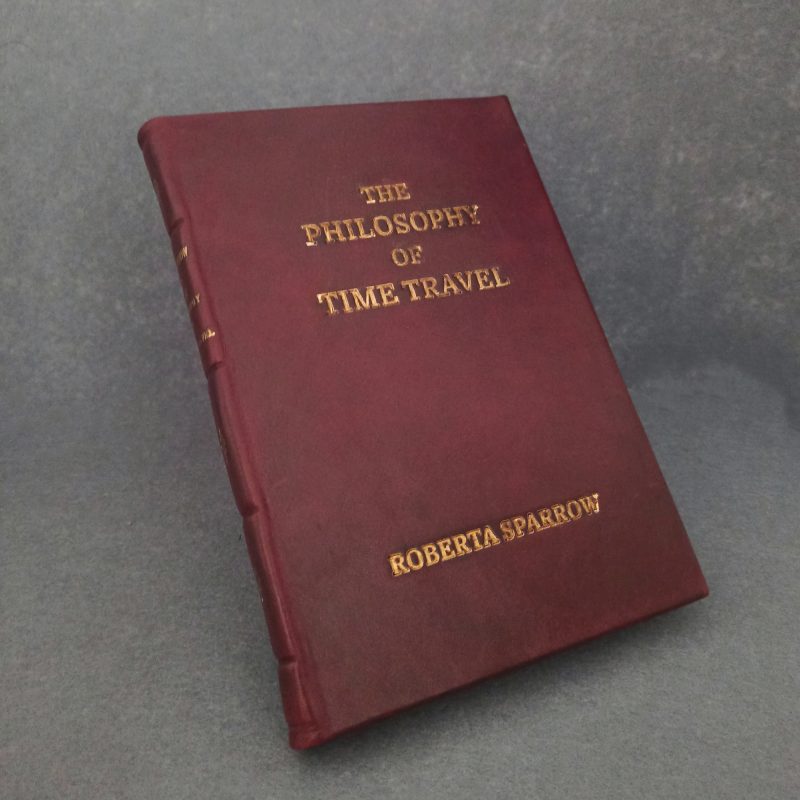
Reading for chrononauts · Limited edition
Philosophy can also cross time
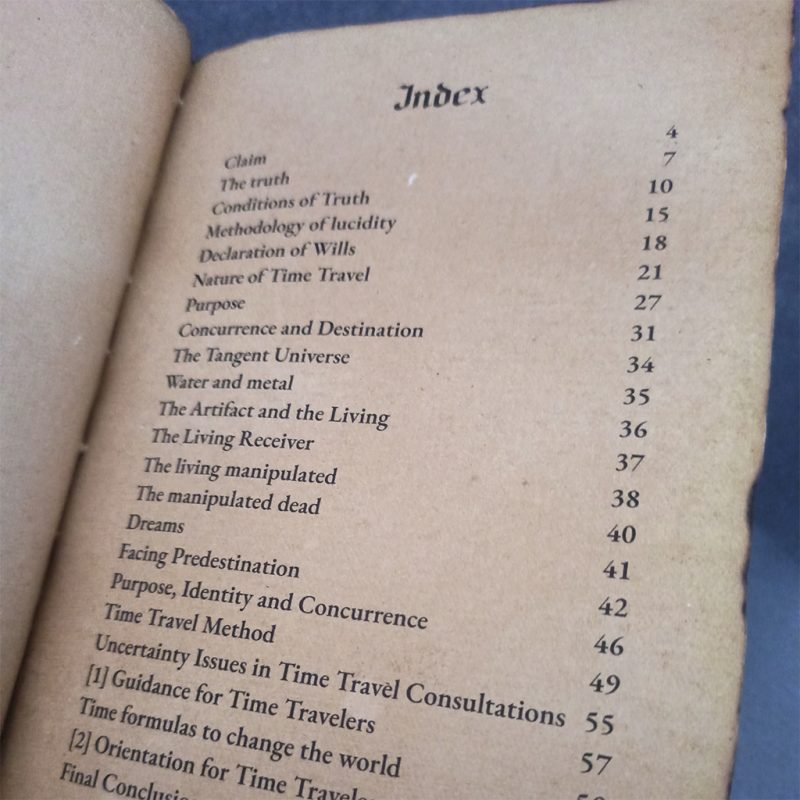
A handmade work that explores the temporary traveler ethics, the concurrence of timelines, destiny and an introspective method to explore one's own history.
- Philosophy and moral standards for time travelers
- Tangent universes, causality, purpose and identity
- Illustrated and handcrafted A5 format
The file, availability and purchase are managed in Verbalus Mater.