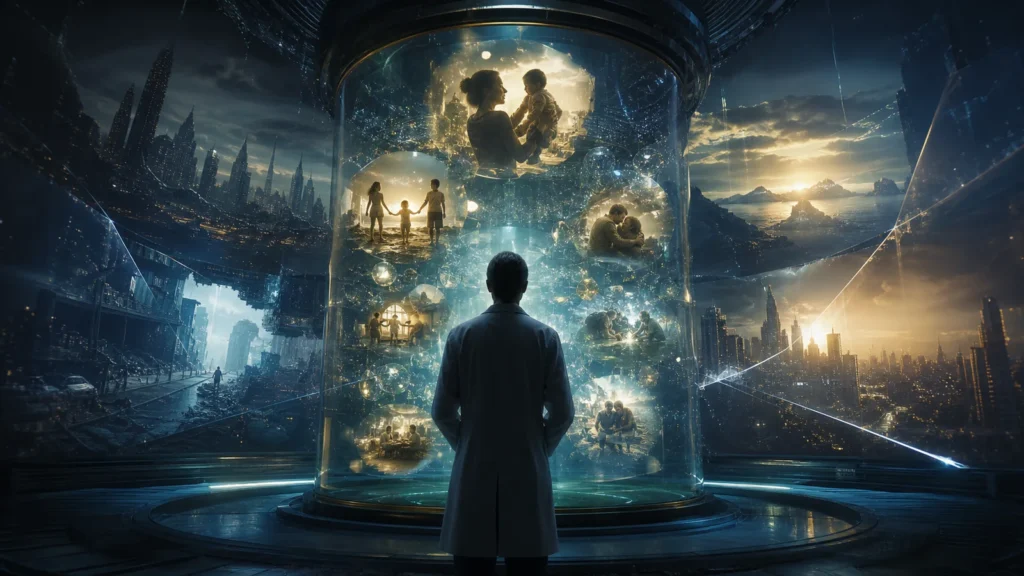
In Recursion, Blake Crouch imagines that memories don't just represent the past: they can become addresses to physically return to. The novel begins as a mystery about people remembering lives they never lived and ends as a global crisis of overlapping chronologies. Your machine does not pierce space-time through speed or gravity; uses memory as coordinate.
This review contains spoilers. We will examine false memory syndrome, Helena Smith's chair, “dead dates,” the multiple lives of Barry Sutton, and the relationship between identity and causality. For the scientific context see our section on physics of time and the article about long-term memory formation.
False memory syndrome
Barry, a New York detective, tries to save a woman who claims to remember a non-existent marriage and child. These alternative memories are as vivid as his official life. The phenomenon is spreading: ordinary people wake up with complete biographies that contradict documents and family members.
The cause is not a conventional disease. When someone travels to a memory and modifies history, the population lives the new chronology without realizing it. Upon reaching the date from which the jump occurred—the dead date— memories of the replaced line return. Two incompatible lives then occupy the same mind.
Helena Smith and a machine to remember again
Neuroscientist Helena Smith investigates technology that allows her mother, who suffers from Alzheimer's, to relive memories. Marcus Slade finances the project and discovers its temporary potential. The chair registers a brain state with enormous precision, induces the experience of a memory and allows consciousness to return to that moment.
The transition from therapy to a time machine is born from a literary hypothesis: a perfect memory would not be a representation, but rather a causal bridge to the brain that formed it. The novel turns the continuity of consciousness into a vehicle. The body does not pass through a portal; mental information occupies its previous version.
What changes when someone returns
The traveler awakens in his past body with knowledge of the future. From that point a new chronology is built. The previous line is no longer public, but continues in the traveler's memory and reappears in others when the dead date arrives. Reality has only one active version and a psychological archive of canceled versions.
This rule avoids physical duplicates, but multiplies identities. Barry lives with Helena for years, loses that world, recovers memories and looks for her again in another story. Is it the same relationship if only one remembers its previous stages? Recursion answers that love can maintain a direction even if its circumstances change, but it also shows the exhaustion of turning every loss into an editable problem.
The epidemic of memories
When technology spreads, governments and individuals return to prevent attacks, get rich, or rescue loved ones. Each intervention produces a new dead date. The population accumulates incompatible marriages, children, wars and deaths. Memory stops organizing identity and becomes a traumatic overload.
The catastrophe does not come only from a logical paradox. It comes from coordination. If many people can rewrite a shared past for different purposes, no history remains stable long enough to sustain institutions. The machine privatizes causality: whoever controls access decides what losses deserve to exist.
Could a memory be a physical coordinate?
In neuroscience, remembering involves reconstructing patterns; not play a perfect recording. Memory changes upon recovery and combines perception, emotion, and subsequent knowledge. We do not know of a mechanism that connects a current neural pattern to the space-time where it originated.
Even an exact copy of the brain state would describe information about the past, not a tunnel to it. Confusing map and territory would be like believing that a photograph functions as a door. The chair is fictional, but the novel correctly uses the reconstructive fragility of memory to pose a conflict: if our memories change, so does the self that makes decisions.
Information, entropy and erased lines
The model requires preserving information from a chronology that was no longer physically produced by that brain. That defies ordinary causality. The traveler transports knowledge without a material channel between the lines. Furthermore, when millions recover canceled memories, the universe seems to store previous states in some medium that the novel does not define.
This license looks like a bootstrap paradox: an idea can travel back and become its own origin. It also generates personal paradoxes. Barry acts for a daughter whose death belongs to another story; pain remains causal even if its object no longer exists in the active world.
Helena and Barry facing the desire to correct
Helena tries to destroy his invention, but each failure provides her with information for another iteration. Barry learns that saving a life can shift suffering somewhere else. Both seek a minimal intervention capable of preventing Slade from turning the chair into a weapon without generating a new expansion.
The structure of the book reproduces that search. The protagonists return to emotionally charged moments and each repetition modifies the meaning of familiar scenes. There is no perfect version; only stories with costs distributed in another way.
Recursion vs. other temporal models
Unlike Predestination, does not require compliance with what happened. Unlike Dark, does not simultaneously maintain a stable genealogy. And unlike Primer, it doesn't duplicate bodies. Its originality is that memory acts as a residue of overwritten universes.
Frequently asked questions
What is a dead date?
It is the moment from which someone jumped into the past. When the new timeline reaches that date, people regain memories of the replaced reality.
Does the chair move the body?
No. It sends consciousness or mental information to the traveler's body at the remembered moment. The novel does not define a physical channel capable of doing so.
Is the syndrome a disease?
It is the clinical name given to memories from previous timelines. Its psychological effects are real within the novel, although the origin is a temporary alteration.
Conclusion
Recursion turns nostalgia into dangerous infrastructure. Returning to a memory seems intimate, but any change reorganizes other people's lives. The novel suggests that accepting the past is not resignation: it is recognizing that a shared history cannot be edited as if it only had one protagonist.
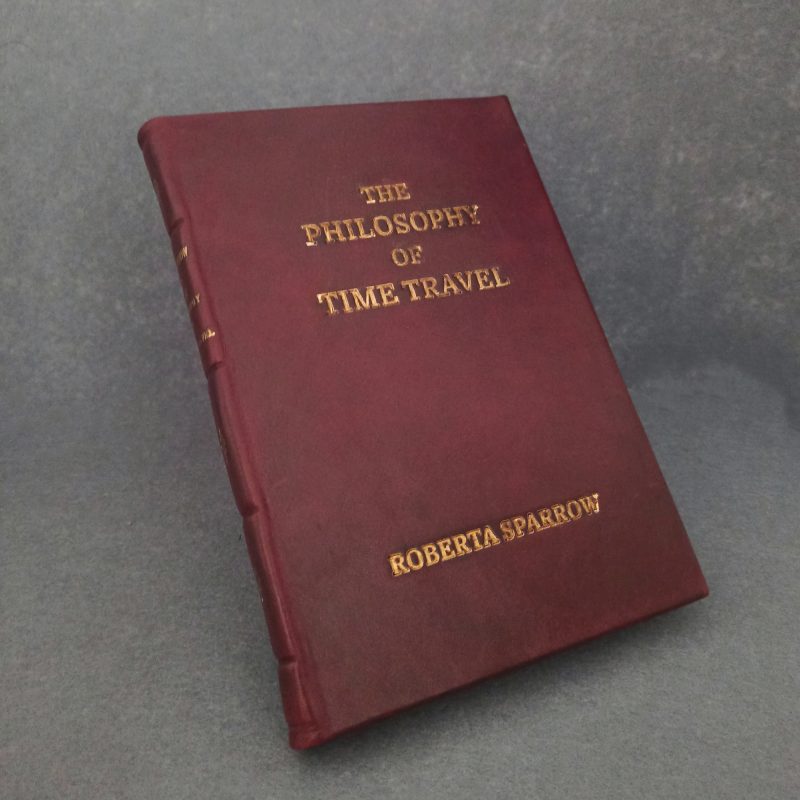
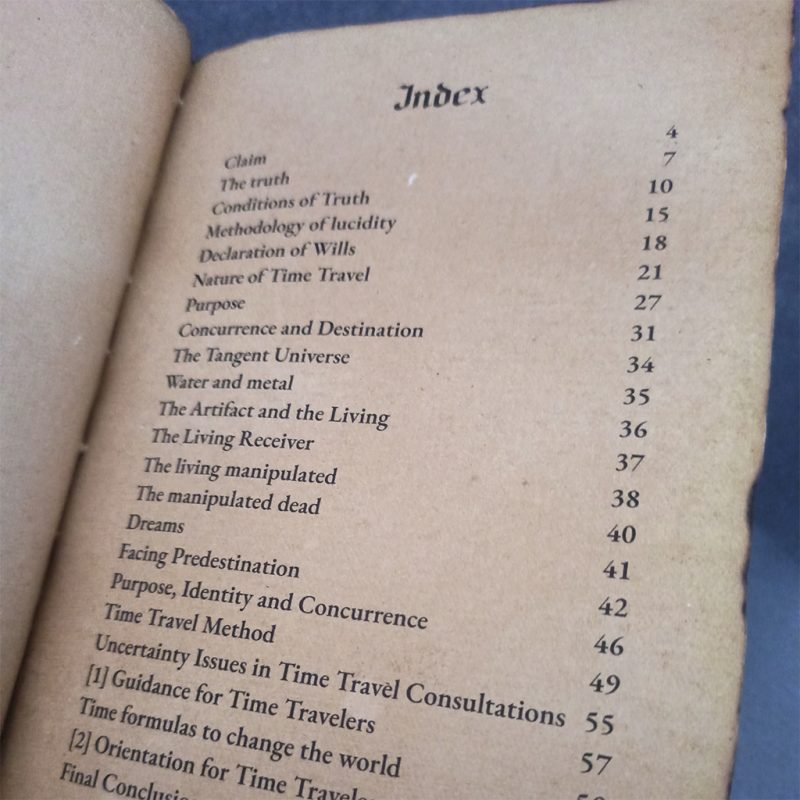
Reading for chrononauts · Limited edition
Philosophy can also cross time
A handmade work that explores the temporary traveler ethics, the concurrence of timelines, destiny and an introspective method to explore one's own history.
- Philosophy and moral standards for time travelers
- Tangent universes, causality, purpose and identity
- Illustrated and handcrafted A5 format
The file, availability and purchase are managed in Verbalus Mater.