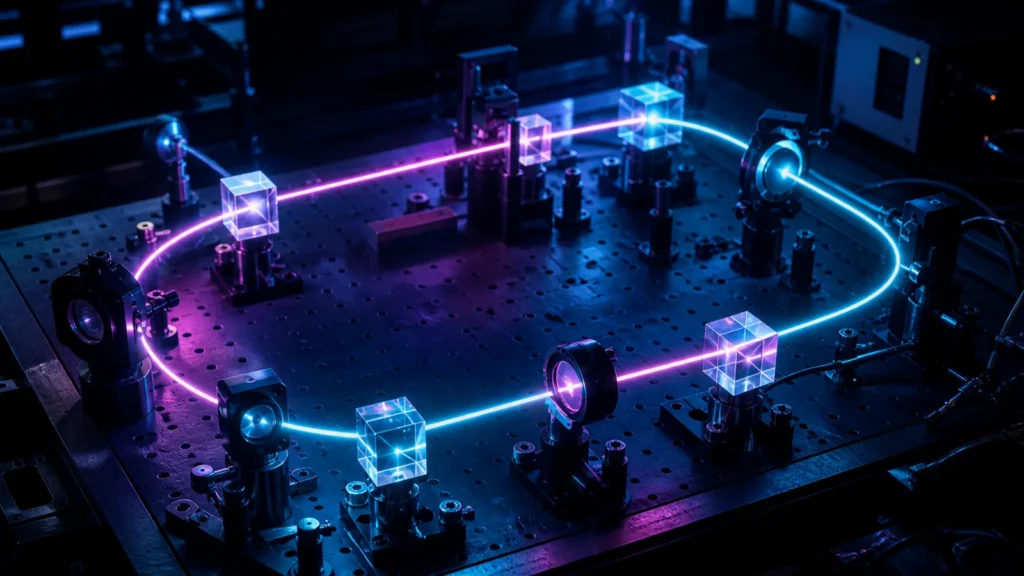
In 2014, a team from the University of Queensland published in Nature Communications a experimental simulation of closed curves of time type. Some headlines presented it as a time travel experiment. The description is attractive, but it requires a fundamental precision: no photons were sent to the past and the laboratory did not create a region of space-time capable of transporting matter. The experiment mathematically reproduced how certain quantum information would behave under a hypothetical model.
We will explain what a closed time curve is, what David Deutsch proposed, what Martin Ringbauer's team simulated and why simulating is not equivalent to building. As a basis you can read our introduction to the closed time type curves and the consistency and paradoxes.
What is a closed time type curve?
In relativity, a world line represents the path of an object through space-time. A closed time-type curve is a trajectory that, staying locally within what is allowed for a material particle, returns to the same event. The traveler could encounter an older version of himself.
Einstein's equations admit solutions with these curves, such as certain rotating universes or idealized geometries associated with wormholes. The fact that a mathematical solution exists does not prove that the universe can produce it. Non-physical conditions, exotic matter, or unstable configurations may be required.
The grandfather problem as a mathematical condition
If a system comes back and prevents the action that sent it back, its state seems contradictory. In classical physics self-consistency can be imposed: only global trajectories without contradiction are allowed. The ball attempting to deflect to its previous version must do so in a manner that produces exactly the observed pitch.
David Deutsch approached the problem using quantum information in 1991. He separated an ordinary system, which respects chronology, and another that follows the curve. After interacting, the quantum state of the second must be the same as the state with which it entered. It is a fixed point condition: the output that returns to the past coincides with the input that caused it.
What is special about the Deutsch model
The condition eliminates contradictions by assigning the curve system a self-consistent, often mixed state. But it introduces non-linear effective evolution for the outer system. That allows extraordinary operations in theory, such as distinguishing non-orthogonal quantum states or cloning information under conditions that ordinary quantum mechanics prohibits.
These capabilities are a sign of caution. They do not show that we can use them; They show how much the rules would change if the hypothetical appeal existed. The model is a proposal to describe quantum causality in a curved spacetime, not evidence that those curves exist.
The Ringbauer et al. experiment
The team implemented an optical circuit with photons to reproduce the input-output relationship of the model. He prepared photonic qubits, performed unitary operations, and used selection and measurement to obtain statistics equivalent to predictions from an interaction with an earlier version of the qubit.
The article studied the discrimination of non-orthogonal states, different preparations of pure states and the influence of decoherence. The result was a simulation of nonlinear behavior. The physical path of the photons progressed normally in laboratory time.
Why simulation is still valuable
Simulation experiments allow us to explore logical and operational consequences of theories that are difficult to realize directly. If a model generates results that are inconsistent with well-tested principles, we can better understand what assumptions produce the conflict. It also helps to study the relationship between linearity, causality and information flow.
The work connects gravity, quantum foundations and information. A complete theory of quantum gravity should explain what causal structures are possible. Investigating extreme models allows us to identify which properties of quantum mechanics depend on an ordinary temporal order.
Non-orthogonal states and impossible advantages
In standard quantum mechanics it is not possible to perfectly distinguish any pair of non-orthogonal states with a single measurement. You also cannot clone an arbitrary unknown state. In Deutsch's model, the nonlinearity associated with the fixed point can circumvent these restrictions.
This is not an available technology. To obtain the advantage as a real resource, the time curve that the circuit only emulates statistically would be needed. Experimental selection has costs and does not turn the device into a channel of information to yesterday.
Has the grandfather paradox been resolved?
It was shown that the model has self-consistent states; not that nature adopts that model. There are other approaches, such as post-selection quantum teleportation curves, that produce different predictions. Without direct observation of a closed temporal geometry we cannot decide which one would describe the universe.
Furthermore, resolving a formal contradiction does not answer all problems: origin of information, thermodynamics, gravitational feedback or stability of geometry. The the chronology protection suggests that quantum effects could prevent the curve from ever forming.
What the experiment didn't do
- He did not send people, particles or messages to the past.
- It did not create a wormhole or a singularity.
- He did not prove that time curves exist in nature.
- It did not allow changing an event that occurred.
- It did not violate causality in the real space-time of the laboratory.
Frequently asked questions
Did a photon meet its past version?
Not physically. The circuit reproduced the model statistics of such an interaction through ordinary preparation, operations, and measurements.
Could it be scaled up to a person?
There is no escalation path. The main ingredient is missing: a real geometry with a closed time curve. Adding more qubits does not transform the simulation into curved space-time.
Why is it called an experiment?
Because it implements and measures a real physical system designed to simulate specific equations. “Experimental” describes the validation of the simulator, not the existence of the simulated phenomenon.
Conclusion
The 2014 simulation didn't build a time machine, but it did something scientifically useful: it turned an abstract discussion about causality into a measurable circuit. Its most important lesson is methodological. Between a mathematical solution, a simulation and a natural phenomenon there are three different levels of evidence. Understanding that difference allows us to marvel at physics without turning each qubit into a time traveler.
Primary sources: D. German, Quantum mechanics near closed timelike lines (1991); M. Ringbauer et al., Experimental simulation of closed timelike curves (2014).
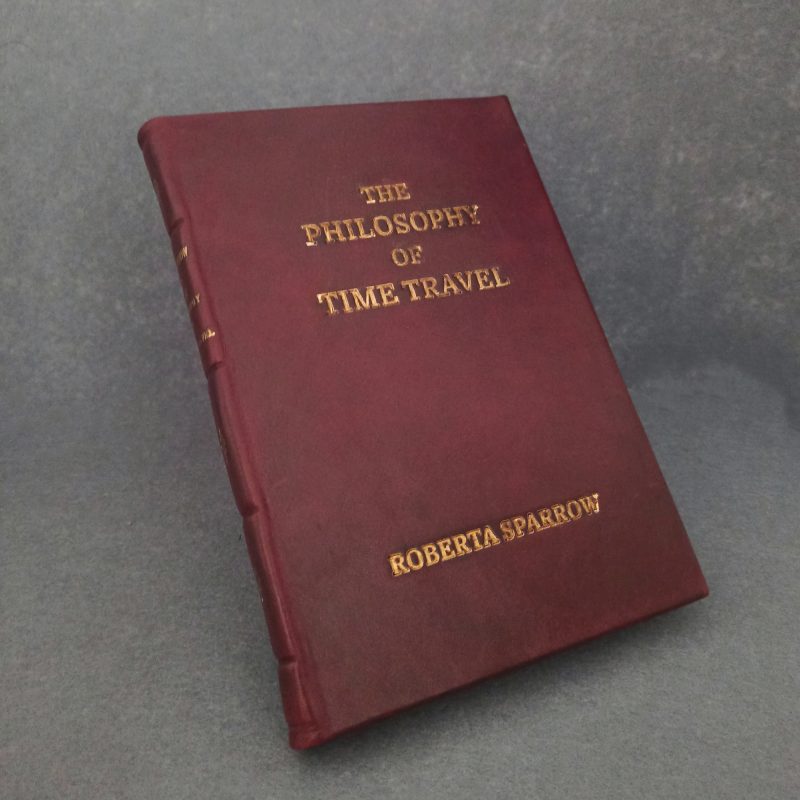
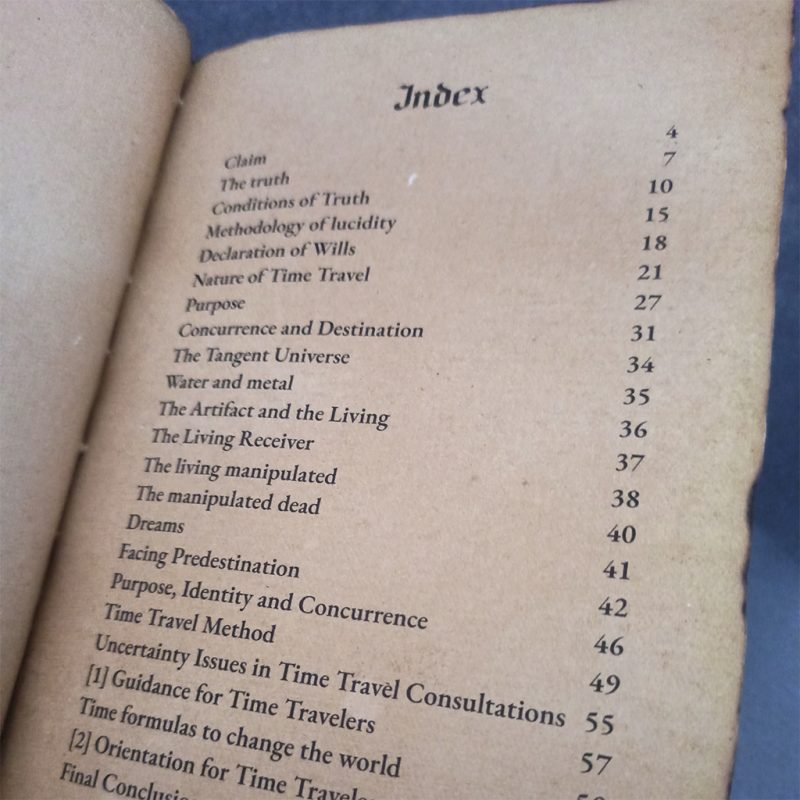
Reading for chrononauts · Limited edition
Philosophy can also cross time
A handmade work that explores the temporary traveler ethics, the concurrence of timelines, destiny and an introspective method to explore one's own history.
- Philosophy and moral standards for time travelers
- Tangent universes, causality, purpose and identity
- Illustrated and handcrafted A5 format
The file, availability and purchase are managed in Verbalus Mater.