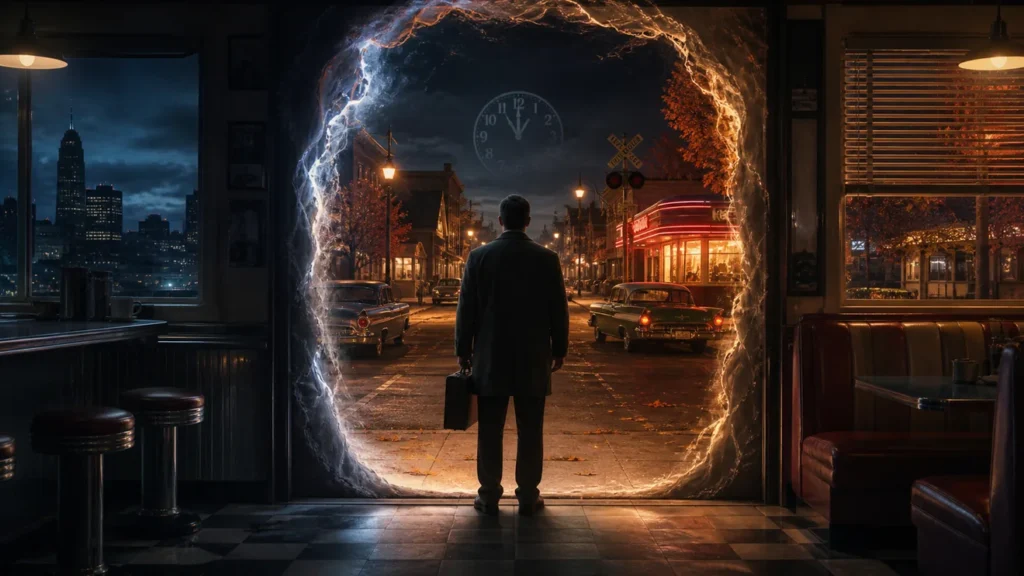
What if you could prevent the assassination of John F. Kennedy? The question seems designed for an alternate history adventure, but Stephen King turns it into something more uncomfortable: an investigation into the price of correcting the past, the fragility of our certainties, and the impossibility of separating one big event from millions of small lives. 22/11/63 —originally published as 11/22/63— uses time travel to talk about history, love, responsibility and loss.
The novel works for readers looking for suspense, historical reconstruction, or a romantic story, even if they don't regularly read science fiction. Its temporal mechanism is easy to understand, but its consequences form one of the richest models of the modifiable past in popular narrative. In this analysis we reconstruct its rules, examine its paradoxes, and ask what real physics brings to a book that never pretends to be a scientific treatise.
What is it about? 22/11/63, without spoiling the ending
Jake Epping is an English teacher in Maine. His life changes when Al Templeton, a restaurant owner, shows him an impossible access hidden in the warehouse. When passing through it, any person appears on a specific day in 1958. The present is left behind, but only approximately two minutes pass regardless of how much time the traveler spends in the past.
Al is convinced that preventing Kennedy's assassination would improve the 20th century. The illness prevents him from completing the mission and Jake agrees to continue it under the identity of George Amberson. Before approaching Lee Harvey Oswald, he has years to test the portal's rules, intervene in tragedies closer to home, and decide if his knowledge of the future gives him the right to transform the lives of strangers.
King does not present 1958 as an innocent postcard. There are cars, songs, dances and food that awaken nostalgia, but also racism, domestic violence, pollution and inequality. The past is seductive because it is full of vivid details, not because it is morally superior. This tension prevents the trip from becoming temporary tourism.
The temporal rules of the novel
A time travel story needs rules that the reader can remember. 22/11/63 establishes a very effective set:
- The portal always leads to the same moment in 1958. It is not possible to select a different date.
- In the present only a few minutes pass. The traveler can live years on the other side without his or her world of origin aging at the same rate.
- Each new entry resets the previous changes. Crossing again is equivalent to deleting the previous intervention and starting another version.
- The traveler preserves his memories. The experience does not disappear even if the timeline is restored.
- The past resists. The more important the change is, the greater the obstacles, coincidences and accidents that try to prevent it seem to be.
- Changing something produces cascading consequences. A well-intentioned action can make the present worse in ways impossible to anticipate.
These rules combine two models. There is a modifiable timeline, because Jake's actions do alter the future, and at the same time there is a restoration point that allows another version to be generated. These are not exactly parallel universes: the story presents each reboot as a replacement for the previous story from the portal's perspective.
You can contrast this system with other works in our comparator of temporal models of cinema and series. Although the tool focuses on the screen, its categories—fixed line, modifiable past, branching, and loop—also serve to analyze novels.
The portal and the asymmetry of the clocks
The detail of the two minutes creates a strong asymmetry: a person can age five years while those who remain in the present barely wait. In real physics, the relativistic time dilation It allows two observers to accumulate different durations if they follow different trajectories or remain in different gravitational fields. However, the novel does not describe extreme speed or intense gravity. The portal connects temporal regions using its own fictional rule.
The difference is important. Relativity allows us to move towards the future of others while accumulating less of our own time; it does not offer a store that leads to a fixed past date. Our time dilation calculator shows what differences speed and gravity would actually make. The result may be surprising, but it does not reproduce King's mechanism.
Narratively, the asymmetry solves a practical problem: Jake can spend years investigating without returning to a present where everyone has aged or given up on him. It also underlines their isolation. For him, years of relationships and losses have passed; for those outside the portal, its absence has barely existed.
The past as a character
One of the best ideas in the book is that the past is not a passive decoration. It behaves like a structure that protects its shape. Breakdowns, illnesses, delays, violence and unlikely coincidences appear as Jake tries to change important events.
There are two ways to interpret that resistance. The first is literal: the universe has some self-correcting mechanism that favors known history. The second is statistical and psychological: changing a complex fact requires controlling too many variables, and Jake perceives the accumulation of normal risks as hostile will. King maintains enough ambiguity to make both readings productive.
The idea is reminiscent of causality protection: the possibility that physical laws prevent configurations capable of creating temporary contradictions. However, in the novel protection is not a theory formulated with equations, but a dramatic force. Its objective is to make each intervention have a cost.
Trial, error and moral responsibility
Resetting offers something we normally don't have: the ability to repeat a decision with knowledge of its consequences. It might seem like an ethical guarantee. If something goes wrong, just cross back and restore the story. But that advantage poses problems.
First, the people from a deleted line were real for jake. Their joys and sufferings disappear from the world, but remain in their memory. Second, restoring the past does not eliminate the traveler's psychological damage. Third, each new attempt turns the lives of others into variables in an experiment.
Jake begins with objectives that seem indisputable: save a family from an attack or prevent a political assassination. However, correct action does not guarantee a better system. The novel distinguishes between the intention, the act and the totality of consequences. That distinction is similar to the philosophical problem of responsibility under uncertainty: how much authority should it give us to know that something terrible will happen, if we ignore everything that preventing it will do?
Lee Harvey Oswald and the value of checking
The mission is not simply to find Oswald and eliminate him. Jake must find out if he acted alone and if the intervention will achieve the goal Al envisions. That wait transforms a fantasy of historical correction into a task of observation: following routines, gathering signals, and resisting acting before having enough information.
This approach adds value to the reader because it shows an essential limitation of knowledge of the future. Knowing that an event will appear in books does not mean knowing all its causes. Historical records condense long processes into dates and names. The traveler, on the other hand, encounters ambiguous people, incomplete decisions and everyday circumstances.
The novel does not resolve historiographic debates through the portal. It uses uncertainty to heighten tension and to question the arrogance of believing that a single intervention can repair an era.
Sadie and the conflict between mission and life
Sadie Dunhill prevents the novel from being reduced to a countdown. The relationship with Jake turns the past into a lived present. It is no longer just the place where an attack will occur: it is a world with emotions, responsibilities and projects.
This change alters the central question. At first, Jake considers whether he should change the story. Then you must decide What story do you consider yours?. His identity no longer completely coincides with the year he comes from. He has built a life under another name and faces a painful truth: restoring a timeline can also mean giving up authentic relationships.
The love story is not an embellishment separate from science fiction. It is the instrument with which King measures the human cost of the reset. If each version can be erased, affection becomes both fragile and precious.
The past defends itself: analysis with spoilers
From here the fulfillment of the mission and the end are discussed. Jake manages to prevent Kennedy's assassination, but pays a devastating personal price. When he returns, he discovers that the resulting future is not the more just and prosperous world that Al imagined. The disruptions have contributed to political instability, conflicts and catastrophes. Furthermore, reality seems damaged by the accumulation of modifications.
The structure rejects the simplistic equation “Kennedy lives = better future”. He does not necessarily claim that the murder was beneficial. He asserts that history is a system of innumerable dependencies and that a large-scale counterfactual prediction cannot rely on hope alone.
Jake must restart the line and allow the historic event to happen again. The decision does not turn evil into good; He recognizes that his experiment produced greater damage and that he does not have enough control to repair it from within.
Is the butterfly effect a sufficient explanation?
The term butterfly effect It comes from the study of chaotic systems: small differences in initial conditions can lead to very different states. In popular culture it is used for any chain of unforeseen consequences. The novel mixes this idea with an active resistance to the past.
Chaos explains why a variation can be amplified, but not why the universe would try to preserve a specific date. Nor does it imply that every small action necessarily produces a catastrophe. Some disturbances are dampened; others grow. The result depends on the structure of the system.
22/11/63 It does not need to prove a scientific theory. It uses chaos as a narrative intuition and adds its own metaphysics: the past is stubborn and certain changes hurt it. That combination makes visible something that equations alone do not express: our inability to anticipate all human consequences.
Guardians and the accumulation of lines
The characters associated with the colored cards suggest that the portal is part of a broader and more dangerous phenomenon. They monitor access and support knowledge of alternative realities. The novel implies that reboots are not harmless and that remembering discarded lines can psychologically destroy the viewer.
This piece prevents the portal from being just a convenient tool. Introduce limits, custodians and signs of deterioration. It also expands the idea of memory: the true privilege of the traveler is not to move, but remember what the rest of the universe has forgotten.
That memory functions as evidence without the possibility of demonstration. Jake knows that other lives existed, but he can't teach them. The problem connects with many stories of rewritten lines: when only one person retains the previous version, his knowledge looks from the outside like an obsession.
The ending: giving up does not mean forgetting
After history is restored, Jake searches for information about Sadie and discovers the life she had without him. The final encounter, when she is old, avoids both easy reward and nihilism. The shared line is gone, but the relationship has changed Jake and perhaps left Sadie with a resonance that's hard to name.
The scene answers the big emotional question of the book: Does an erased experience have no value? Not for Jake. Its moral effect remains on the person who returns. Objective time may have been restored, but the traveler's biographical time does not go back.
This outcome turns time travel into a metaphor for grief. We cannot preserve all possible futures. Choosing one life means losing others, and maturing means accepting that love does not always grant the right to possess the desired result.
What temporal model do you use exactly?
We can summarize the system 22/11/63 through five components:
- Pinned Access: The portal has a fixed destination date.
- Rewritable history: the past admits real changes.
- Restoration: a new entry eliminates the previous intervention.
- external memory upon reboot: the traveler preserves what he experienced.
- causal resistance: history favors its known configuration.
It is not a bootstrap paradox, because the main information is not without origin: Jake obtains his data from the future before traveling. It is also not a the grandfather paradox classic, although each change could affect the conditions that allowed the trip. The reboot and anchoring of the portal partially isolates that contradiction.
Comparison with other stories
Facing Back to the future
Both present a modifiable past and a traveler who preserves memory. The difference is in the reboot. Marty cannot automatically restore the original story; Jake does have an erase point, although using it has a psychological and metaphysical cost.
Facing Dark
Dark It builds much of its plot on closed causality: trying to avoid an event can produce it. King allows it to be changed, but transforms the change into a threat. One work asks how to escape a cycle; the other, if we should break it.
Facing The end of eternity
In Asimov's novel, an organization changes centuries through calculations and bureaucracy. Jake acts practically alone and out of affection. Both accounts warn that optimizing history requires moral criteria that no calculation fully provides. You can read our analysis of The end of eternity.
What can a writer learn from this novel?
- A simple rule can generate enormous complexity. The fixed portal and reset are easy to explain, but produce profound decisions.
- The world visited must have life outside the mission. The school, the town and Sadie turn the era into more than just historical information.
- The cost matters more than the machine. The reader remembers what Jake loses, not the engineering of the portal.
- The consequences must respond to the topic. The altered future expresses the limits of control, not an arbitrary list of surprises.
- Nostalgia needs contradiction. Showing beauty and violence avoids idealizing the past.
If you're building a story of your own, you can sort causes, reboots, and versions with our timeline builder.
Frequently asked questions about 22/11/63
Is it necessary to know the history of the United States?
No. The novel provides the necessary context. Knowing details about Kennedy and Oswald adds nuances, but the plot is sustained as suspense and human drama.
Is it hard science fiction?
No. The mechanism is not derived from a developed physical theory. It's a fantastic premise with consistent rules, used to explore causality and history.
Does the novel claim that saving Kennedy would have been negative?
It presents a concrete fictional future, not a demonstrable historical prediction. Its goal is to question the confidence with which we attribute global consequences to a single modification.
Is the past conscious?
The text allows us to interpret it this way, but it also allows us to read its resistance as a personification of causal complexity. Ambiguity is part of its appeal.
Why can't Jake just stay with Sadie?
Because the version in which they share their life is linked to modifications that damage the future. Choosing it would mean accepting those consequences to preserve your happiness.
Conclusion: changing history is not understanding it
22/11/63 It starts from an irresistible fantasy and ends up defending a more mature idea: Being able to intervene is not equivalent to knowing what intervention is fair. Knowledge of the future offers local advantage, but not omniscience. A historical date contains millions of relationships that no traveler can control.
The novel stands out because it balances spectacle and intimacy. Kennedy's assassination provides a recognizable mission; Sadie, Harry Dunning and Everyday Lives reveal what's really at stake. The past can be reset, but the traveler does not return intact.
That is why its ending does not say that we should passively accept all injustice. He says responsibility requires understanding limits, listening to consequences, and giving up the illusion that a single person can redesign the world without losing anything. In an era obsessed with correcting previous decisions, that lesson is as disturbing as the portal itself.
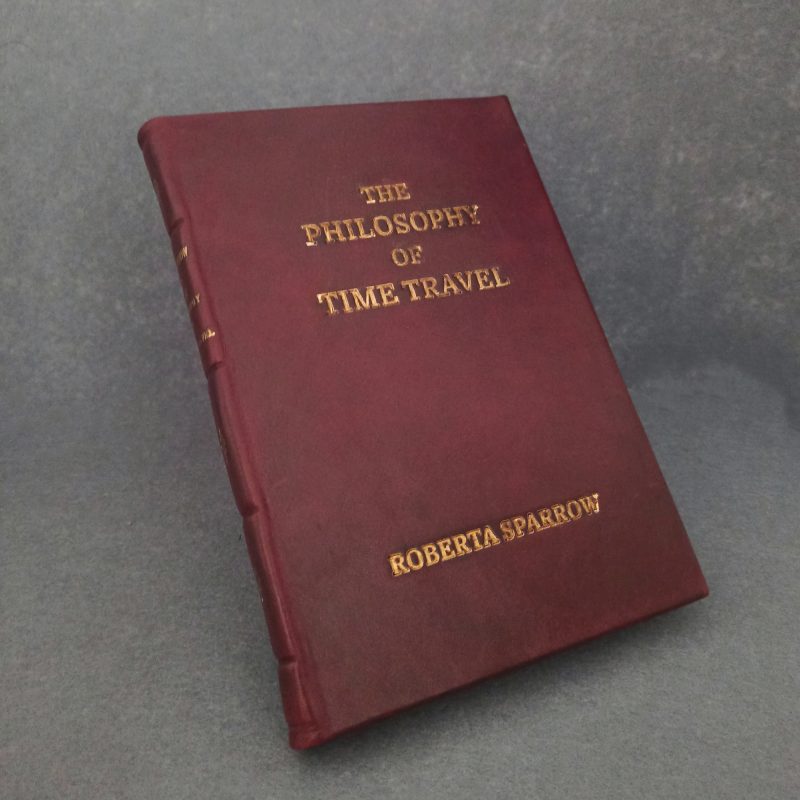
Reading for chrononauts · Limited edition
Philosophy can also cross time
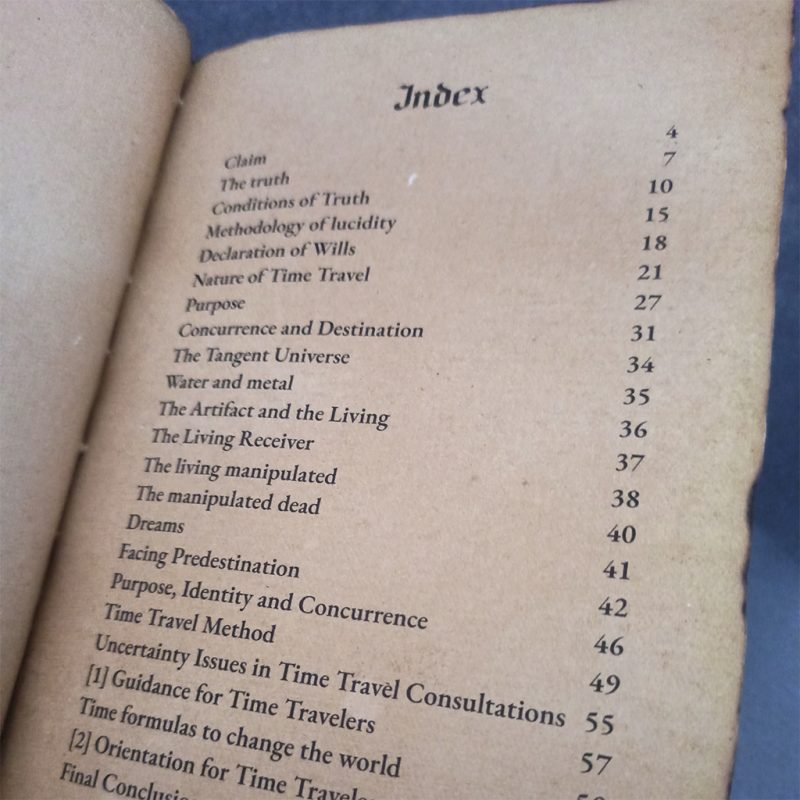
A handmade work that explores the temporary traveler ethics, the concurrence of timelines, destiny and an introspective method to explore one's own history.
- Philosophy and moral standards for time travelers
- Tangent universes, causality, purpose and identity
- Illustrated and handcrafted A5 format
The file, availability and purchase are managed in Verbalus Mater.