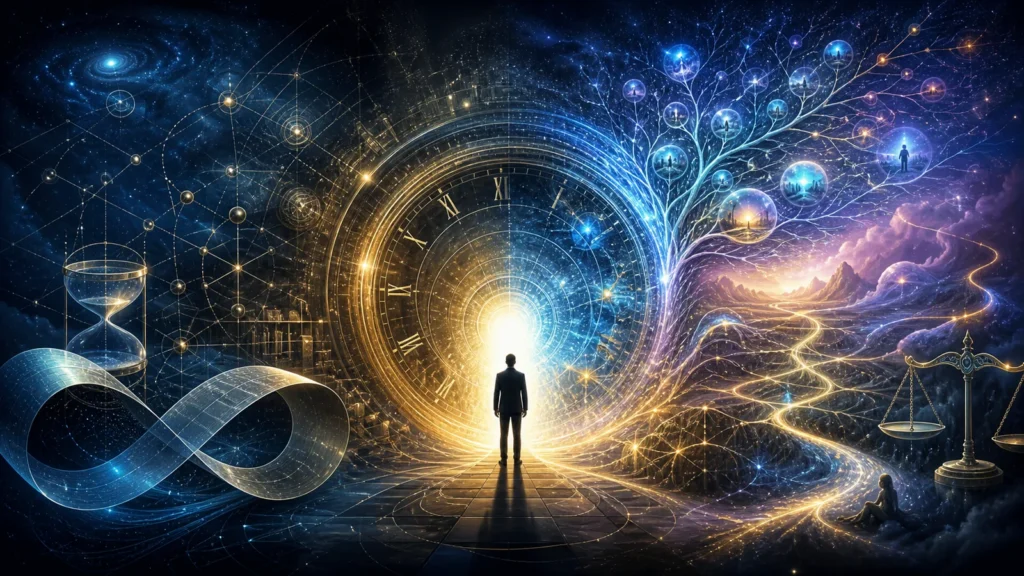
Thinking about time does not only consist of imagining a machine capable of taking us to another year. It also means asking ourselves What is the present, how does consciousness construct duration, to what extent are we free and what responsibility would we have if we could intervene in a history already lived?. The course Time, Reality and Consciousness: Paradoxes, Ethics and Freedom, available on the Time Travelers platform, proposes precisely that shift: moving from the spectacle of time travel to the questions that make it intellectually disturbing.
Physics can describe how two clocks stop matching when they follow different trajectories. Philosophy, however, asks what it means for two people to have lived different durations, whether it is still the same person who reaches the future, and what obligations arise from knowing consequences that have not yet occurred for others. This course is located at that intersection between science, experience and decision. Its value is not in promising a fantastic recipe for escaping the present, but in offering a framework for think more precisely about the temporal reality we already inhabit.
Why time requires more than equations
In our library about the science of time We analyze physical mechanisms such as relativity, wormholes or closed time curves. These theories are essential to separate a mathematical possibility from a realizable machine. But even a complete physical description would leave fundamental questions open. Is there really a universal present? Is the passage of time a property of the world or a way of organizing experience? Can a cause come from the future? Would it be moral to correct past harm if doing so eliminated subsequent lives, decisions, and relationships?
These questions are not literary embellishments. They appear when we try to interpret the human meaning of real physical models. The velocity time dilation, for example, allows a traveler to accumulate less time than those who remain on Earth. The phenomenon is measured and does not require reversing causality. However, its biographical consequence is profound: the traveler could return to an aging society while his own body has barely changed. The equation calculates the difference between clocks; It does not alone explain the grief, the identity or the responsibility of choosing that leap.
The course starts from that border. It brings together five blocks—introduction to the philosophy of time, cultural conception, reality and consciousness, paradoxes, and ethics—that can be understood as stations on the same itinerary. First we learn to formulate the problem. Then we observe that our idea of time is not neutral. Next we examine the relationship between world and experience. Finally we enter into the paradoxes and their moral consequences.
First station: getting into the philosophy of time
The philosophy of time investigates what kind of entity time is and how past, present and future are related. A first family of positions maintains that only the present exists. Another defends that past, present and future events are part of a complete structure, although we traverse a limited perspective within it. Between both extremes there are proposals in which the past exists and the future remains open, as well as theories that distinguish the order of events from the sensation that time flows.
It is not necessary to memorize labels to appreciate the problem. It is enough to prove its consequences. If only the present exists, what does it mean to say that a past event was real? If all space-time exists, in what sense can our decisions still be open? If the future does not exist, how do we interpret physical solutions in which geometry seems to fix a global history? The course helps turn vague intuitions into comparable questions, and that clarity is one of the best tools against pseudoscientific explanations.
The issue also affects identity. We tend to treat ourselves as beings that persist over time, but our bodies, memories, projects, and relationships continually change. A person traveling by means of a wormhole It would have to retain enough physical and psychological continuity for the term "traveller" to continue to have meaning. If the procedure created a perfect copy at another time, a different dilemma would arise: has the individual moved or has another individual with its memories originated?
Second season: the time each culture learns
The lesson dedicated to the conception and cultural perception of time is especially important because it avoids confusing a social custom with a natural law. Societies organize calendars, work cycles, rituals, ages, promises and collective memories in different ways. There are linear representations oriented towards progress, cyclical visions linked to repetition and models where the past remains actively present in the community.
None of these constructions modify relativity or thermodynamics, but they do modify the way we experience them. A minute measured by an atomic clock is reproducible; A minute of waiting, fear, concentration or joy is not experienced in the same way. The difference between measurement and experience explains why the physics of time and temporal psychology must dialogue without replacing each other.
This perspective allows us to recognize the extent to which technology shapes the present. Notifications fragment attention, digital archives maintain previous versions of ourselves, and recommender systems use the past to anticipate future decisions. In a sense, we live surrounded by small memory and prediction machines. They do not transport matter to another time, but they alter the weight that the past and the future have in current behavior.
Asking who controls these records already introduces an ethical dimension. A culture that can preserve almost anything must decide what deserves to be remembered, who has the right to forget, and how to prevent a statistical prediction from becoming a condemnation. Temporal philosophy then ceases to be abstract: it affects privacy, justice, education and the possibility of change.
Third station: reality, consciousness and lived present
The brain does not receive a perfectly instantaneous “now.” It integrates signals that arrive with different delays, compares patterns, and builds an experience coherent enough to act on. Temporal awareness includes immediate memory, attention, and anticipation. We hear a melody because we retain the previous notes while waiting for the next ones; If there were only one point without thickness, we would perceive isolated sounds and not a musical phrase.
Just because the experience is constructed does not mean that the outside world is an illusion. It means that we must distinguish between physical time, biological time and phenomenological time. The first is formalized through clocks, causal relationships and geometry. The second appears in circadian rhythms, aging and neuronal processes. The third describes what it feels like to wait, remember, or project. Confusing them produces misleading statements: a mental practice can change the perception of an hour, but this does not alter the duration itself calculated by relativity.
The relationship between consciousness and reality also opens up a fascinating question: why do we remember the past and not the future? The physical explanation connects the records with the arrow of time and increasing entropy. Forming a memory requires material processes that leave traces and consume energy. Our psychological orientation does not float outside of nature; It is embodied in systems that evolve out of equilibrium.
This connection provides a lesson in caution. Consciousness continues to pose open scientific and philosophical problems, but these gaps do not justify attributing to it unlimited powers over matter or the past. A valuable course must keep the question alive without turning the mystery into a commercial certainty. The Time Travelers proposal is more fertile when it is used as a map of problems and not as a substitute for evidence.
Fourth station: paradoxes that test a theory
Temporal paradoxes are thought experiments with a rigorous function: to reveal incompatibilities between our assumptions. The famous grandfather paradox asks what would happen if a traveler prevented a necessary condition for his own birth. If successful, he would never exist to make the journey; If it exists to travel, it can't seem to succeed. The conflict forces us to review the idea of freedom, the causal structure or the number of possible stories.
One answer is Novikov consistency conjecture: Only events compatible with the entire story can occur. The traveler could act, but his actions would be part of the past that he already knew. Another possibility resorts to parallel universes: The intervention would open or reach a different branch, so it would not erase the origin of the traveler. Both solutions avoid contradiction, although they pay different philosophical prices.
The bootstrap paradox poses another problem. An object or information travels to the past and becomes the cause of its own future existence. A composer receives a score from her older self, publishes it, and years later gives that same score to her younger self. The chain is consistent, but appears to lack an external creative origin. The question is no longer “can it happen?” and it becomes "what explains the existence of the information?"
The retrocausality Quantum adds nuance, although it does not provide a proven channel for sending usable messages to the past. Some interpretations and formalisms allow correlations to be described using future conditions, but that does not mean that a person can change yesterday. The course offers an appropriate context to learn to distinguish a narrative inversion, a physical interpretation and an experimental technology.
Fifth station: ethics and responsibility in the face of time
The ethics of time travel often boil down to one spectacular question: "Would you kill a person in the past to avoid a catastrophe?" But the real problem is much broader. Intervening in a story means acting on people who have not given their consent and accepting consequences that may be impossible to calculate. Even a well-intentioned modification could eliminate relationships, births, discoveries, and projects that depended on the original sequence.
A moral asymmetry then arises. The traveler has information that the inhabitants of the past do not have. That advantage can make you a protector, manipulator or tyrant. With what legitimacy does it decide what future deserves to exist? Should you reveal a tragedy if the warning could cause it? Do you have an obligation to rescue someone when doing so alters countless subsequent lives? Time travel stories are moral laboratories because they exaggerate an everyday condition: we always decide with incomplete information, and our actions transform futures that will affect other people.
Responsibility towards our future self also matters. Saving, studying, taking care of your health or repairing a relationship are ways of acting over time. The beneficiary will be a version of ourselves that we have not yet directly experienced. Thinking about personal continuity helps to understand why a present decision can be free and, at the same time, be linked by commitments to future people.
Temporal ethics extends to collective problems. Climate change, nuclear waste or the conservation of knowledge distribute risks and benefits between generations. Those who will live a hundred years from now cannot vote in our institutions, but they will suffer part of our decisions. The question about the temporary traveler thus becomes a very current political question: What do we owe to those who have not yet been born?
Freedom, determinism and the possibility of choosing
If an entire story is already part of space-time, it might seem like freedom disappears. However, the philosophical debate is not resolved simply by declaring that the universe is deterministic or indeterministic. Nor does chance by itself create a responsible choice. A decision is free, according to many contemporary positions, when it comes from the reasons, values and capabilities of the agent, even if it is part of a causal chain.
The closed time type curves they intensify the problem. If the traveler returns to a remembered event, he may feel that he is choosing between several actions, but the overall story requires consistency. Does its inability to produce a contradiction eliminate freedom or is it like any other physical limitation? We are also not free to breathe underwater without help, and that does not make all our decisions irrelevant.
A productive reading of the course consists of abandoning the simple opposition between absolute destiny and unlimited will. Our freedom always operates within conditions: body, history, language, resources and knowledge. Understanding those conditions does not destroy agency; can improve it. The better we recognize the mechanisms that influence a choice, the more capable we are of deliberating, correcting habits, and assuming consequences.
What can this course provide to the student?
The course is organized into five lessons and is in Spanish and English. The platform presents it as an accessible introduction, so it is not necessary to master tensor calculus or have prior philosophical training. Its best audience is science fiction readers, curious students, teachers, writers and anyone interested in connecting temporal narratives with questions about identity, reality and responsibility.
Learning should not be measured by the number of definitions memorized, but by the improvement of the questions. Upon completion of a route of this type, the student should be able to:
- Distinguish a statement about the physical measurement of time from another about its subjective experience.
- Recognize the main tensions between presentism, block universe and open future.
- Analyze a paradox without confusing logical consistency with technological feasibility.
- Identify dilemmas of consent, power and intergenerational responsibility.
- Interpret films, novels and time series with a more precise vocabulary.
- Relate everyday decisions to the continuity between the present self and the future self.
It is advisable to accompany each lesson with a notebook of questions. There is no need to write definitive answers. It may be enough to record what intuition changed, what argument is stronger and what information would be missing to decide. This practice turns passive consumption into personal research.
How it dialogues with the real physics of time
Philosophy is most useful when it converses with the limits established by science. Special relativity shows that there is no universal duration independent of motion. General relativity describes how gravity and geometry affect clocks. Thermodynamics explains why macroscopic processes show direction. Quantum physics challenges some classical intuitions about measurement and causality, but it has not produced a machine capable of transporting people to the past.
Models like the Godel's universe, he cilindro de Tipler oh go Kerr black holes They contain mathematical structures that defy chronology. However, they often depend on ideal conditions, inaccessible regions or extreme instabilities. The the chronology protection proposes that quantum effects could prevent an acausal region from forming.
Knowing these limits protects the philosophical value of the topic. We don't need to pretend that a time machine is about to be built for the questions to matter. Mathematical possibility, practical impossibility, and narrative imagination can coexist if they are honestly labeled.
TimeTravelers.cc as a temporary learning platform
TimeTravelers.cc brings together courses focused on science fiction, physics and philosophy of time. The proposal combines an educational platform with a thematic itinerary: it does not present time as an isolated curiosity, but as a meeting point between cosmology, narrative, consciousness and culture.
In addition to the course on reality and consciousness, the platform shows training dedicated to the real science of time travel, the history and key concepts of time fiction, and methods of exploring the topic. This allows you to build a progressive route. A student can begin with the narratives they already know, continue with the physical foundations, and end in the philosophical dilemmas that those theories generate.
The course sheet includes presentation videos in Spanish and English, five lessons, access in both languages and practical registration information. At the time of this review it appears with a price of 9.95 euros; As commercial conditions may change, it is advisable to always check the figure and access directly on the official website.
The platform is especially coherent with Time Travelers because both projects fulfill complementary functions. This blog offers open articles, extensive analysis, and a linked library of theories. The course provides a concentrated learning sequence. The reader can investigate each concept here and use the training as a common thread so as not to get lost between disciplines.
A recommended route to make the most of it
- Before you start: Write down your spontaneous definition of time and if you consider that past and future exist.
- After the introduction: Compare that definition with at least two different philosophical positions.
- In the cultural part: Identify what calendars, schedules and technologies organize your daily life.
- In conscience and reality: separates examples of physical, biological, and lived time.
- When studying paradoxes: Write which assumption modifies each solution: causality, consistency, identity or branching.
- In the ethics lesson: Choose a case and analyze affected parties, consent, uncertainty and distribution of risks.
- When finished: Go back to your initial definition and explain what has changed and why.
This route turns five lessons into an extended conversation with our own intuitions. It also makes it easier to translate what you learn into a novel, a movie, or a scientific debate. When a time machine appears in a story, we will no longer just ask how it works: we will ask what ontology it entails, what model of causality it uses, and who bears the moral cost of altering history.
Questions worth asking
- Would you still be you after losing all your memories?
- Can freedom exist in a globally consistent story?
- Is it moral to avoid a tragedy if the intervention erases subsequent lives?
- Why do we attribute more reality to the remembered past than to the anticipated future?
- What obligations do we have to future people who cannot respond?
- Would a copy with your memories be a continuation or a new individual?
- What evidence would you need to accept an extraordinary claim about consciousness and time?
There is no simple answer that closes all these questions. That is precisely its value. Good temporal questions force us to make explicit ideas about person, cause, knowledge, and justice that normally remain hidden.
Conclusion: learning to inhabit time
The attraction of traveling in time is often born from the desire to repair a loss, recover a possibility or contemplate that which does not yet exist. Behind the imaginary technology there are real emotions: regret, hope, fear of irreversibility and need for meaning. A course on time and consciousness is worth it when it does not exploit those emotions, but rather turns them into an opportunity to think better.
Time, Reality and Consciousness: Paradoxes, Ethics and Freedom proposes an accessible gateway to that territory. Its five axes allow us to go from the nature of time to the responsibility of intervening in it. It does not promise to escape our times. It offers something perhaps more useful: tools to understand why the past matters, why the future matters, and how a present decision connects the two.
A ROUTE TO THINK BEYOND THE CLOCK
The next trip can change the way you look at the present
Explore five lessons on the philosophy of time, culture, consciousness, paradoxes, and responsibility. Available in Spanish and English within Time Travelers.
Reading for chrononauts · Limited edition
Philosophy can also cross time
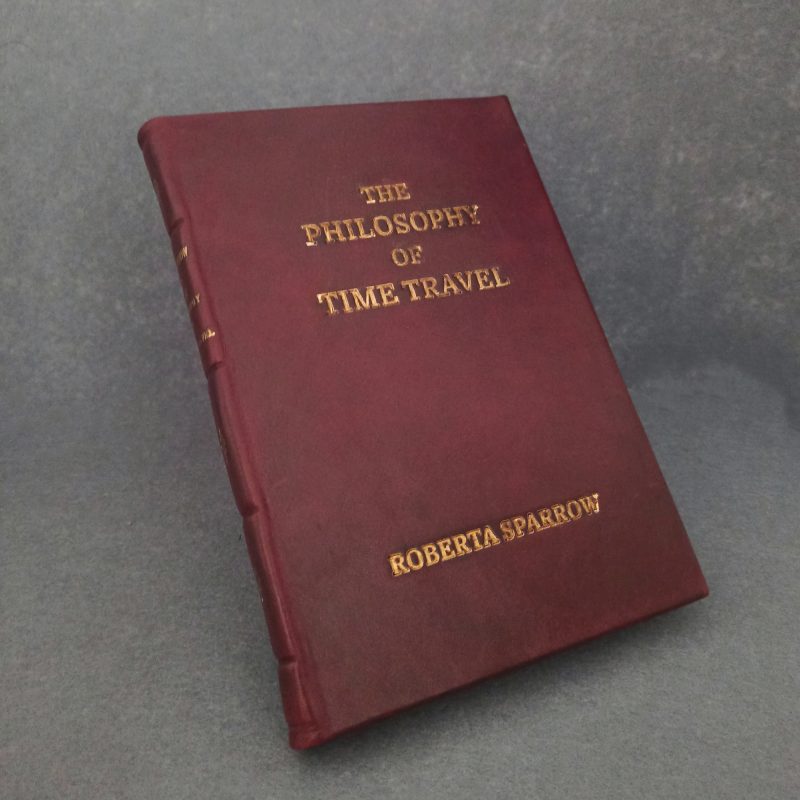
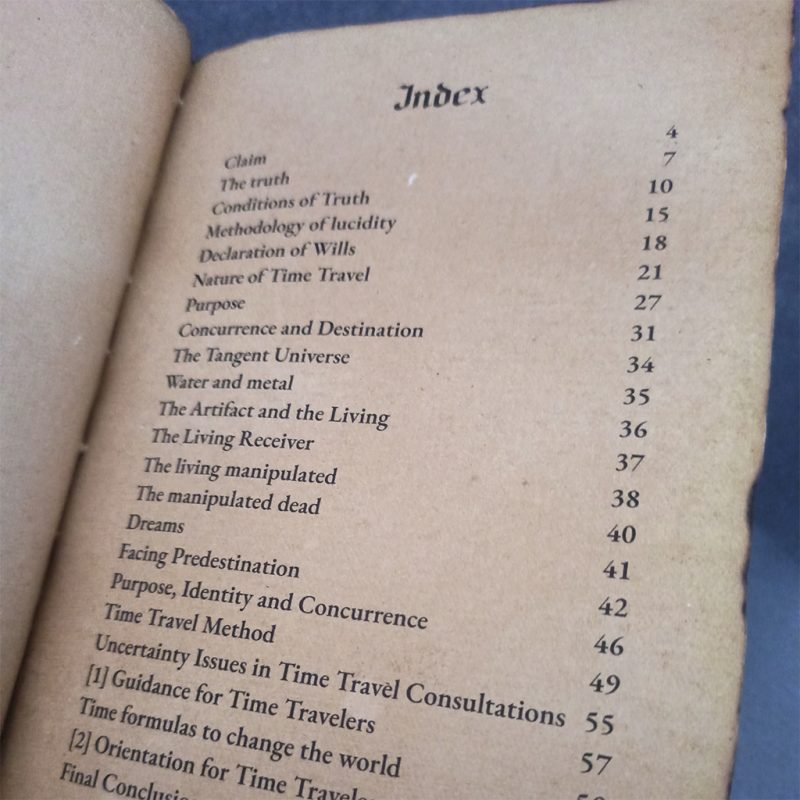
A handmade work that explores the temporary traveler ethics, the concurrence of timelines, destiny and an introspective method to explore one's own history.
- Philosophy and moral standards for time travelers
- Tangent universes, causality, purpose and identity
- Illustrated and handcrafted A5 format
The file, availability and purchase are managed in Verbalus Mater.