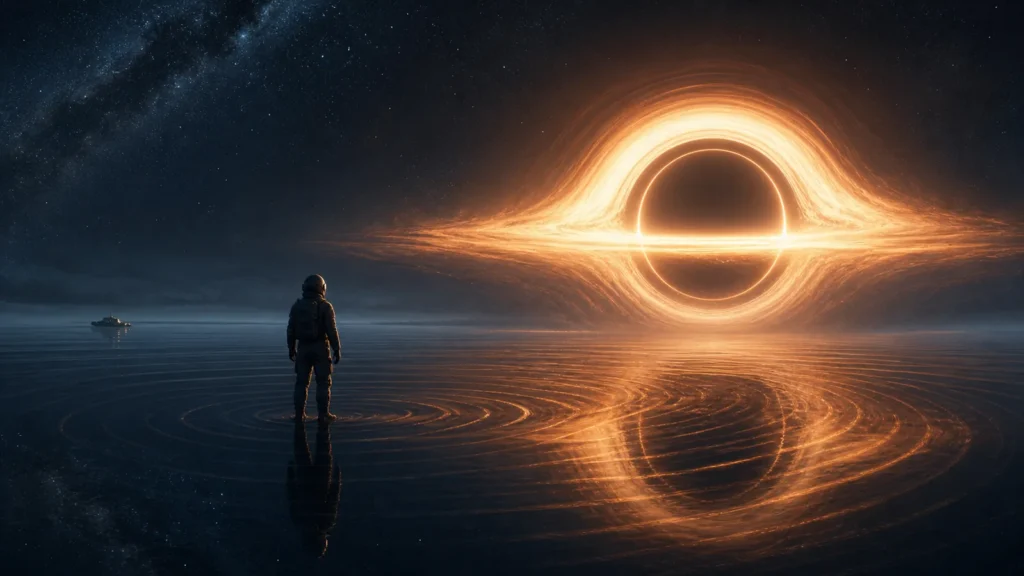
This review contains spoilers for Interstellar. Christopher Nolan's film turns an equation into an intimate conflict: the closer Cooper gets to the place where time is warped, the further he moves away from his children's lives. Its great success does not consist in stating that "everything is relative", but in making visible that two legitimate trajectories can accumulate radically different amounts of time.
The temporal argument: a mission measured by absences
The Earth is going through an agricultural and environmental crisis. Cooper joins a mission crossing a wormhole near Saturn to evaluate worlds around Gargantua, a supermassive black hole. While the team searches for a future for the species, Murph attempts to solve the gravitational equation on Earth that would allow the population to be evacuated. History runs on two clocks: that of the expedition and that of those who wait.
The journey does not employ a single "machine." The wormhole resolves spatial separation; Gargantua produces extreme gravitational dilation; The tesseract offers Cooper narrative access to different moments in Murph's room. Each piece does a different job. Confusing them leads to thinking that the black hole automatically sends us to the past, when the film reserves that function to a structure built by future intelligences.
Miller's Planet: One Hour vs. Seven Years
The planet orbits very close to Gargantua. For the team on the surface, one hour corresponds to approximately seven years away from the gravity well. General relativity allows a clock deep in a strong field to accumulate less time. The principle is real and verified; The extraordinary thing is to achieve that factor while maintaining a habitable orbit.
The model demands that Gargantua be huge and turn almost to the limit. A supermassive black hole reduces tidal forces on the horizon compared to a small one, and the rotation allows for closer stable orbits. Still, the combination of accretion disk, radiation, orbital stability, and water planet makes the scenario an extreme fit. The film chooses the edge of the mathematically defensible so that a delay of minutes has a cost of decades.
The subsequent scene, when Cooper receives years of messages, translates the metric into loss. He has not traveled "instantly" to the future: he has lived a few hours while others have lived an enormous fraction of their lives. It is a unilateral trip to the future and belongs to the same physical family as the gravitational time dilation.
Gargantua as a visual object
The image of the disk curving above and below the shadow represents gravitational lensing: light from the back travels along curved paths and appears around the hole. The visualization was developed with advice from physicist Kip Thorne and led to technical work on black hole spacetime cameras. The representation simplifies brightness and color shifts so that the viewer can read it, but communicates a truth: we do not see a flat disk as if gravity did not exist.
The wormhole and the hand in space
A traversable hole can be represented as a sphere, because a three-dimensional mouth would not be a flat circle. The distortion of the stars indicates that the light travels through multiple geometries. Brand's contact inside the tunnel anticipates that Cooper, from another temporal structure, will interact with that moment. The gesture is a causal clue and also a promise: what seems supernatural will have an internal source.
The tesseract and the gravitational message
After falling into Gargantua, Cooper should not emerge unscathed according to known physics. The film introduces a construction of future beings that represents habitation time as a navigable dimension. Cooper doesn't arbitrarily change every moment; It transmits data through gravity: first patterns that Murph interprets as ghosts, and then quantum information through the clock.
The loop is self-consistent. Cooper arrives on the mission because the coordinates are sent from his future, and he ends up sending them because he completed the mission. Critical information inside is completed by TARS observations. The origin of the path forms a circuit: there is no first external version of the intervention. It's a bootstrap paradox, not a contradiction.
Love, dimension and metaphor
The film does not rigorously claim that love is a measurable physical force like gravity. He uses it as a human ability to maintain a relationship over time and select who to seek out among countless events. The mechanics allow transmission; the link determines the recipient. Reading the phrase as an equation impoverishes the scene and reading it only as sentimentality ignores its narrative architecture.
How to draw the timeline without getting lost
The most reliable way to analyze Interstellar It consists of separating three layers. The first is the order of presentation: what the work decides to teach us and the moment in which it reveals it. The second is the chronological order of events within the narrated world. The third is the time of each character, that is, the sequence that his body remembers even though the montage jumps from one date to another. In this case, the dominant model is a single self-consistent story combined with differential journeys into the future. Mixing the three layers produces false contradictions; Keeping them separate allows us to locate the authentic mechanism of each turn.
A useful diagram starts with one arrow per character. Each departure, arrival, encounter with another version and transfer of information must be marked. Then the events that are the same event seen from different perspectives are joined. In Interstellar, the point that organizes the map is Cooper's stay on Miller's planet and the messages accumulated during his absence. Around this node we understand why a scene that seemed like a cause can be, at the same time, a consequence of a subsequent action. It is not necessary to memorize dates: it is enough to follow what each person knows before and after crossing the temporal mechanism.
It is also important to distinguish a loop from a repetition. In a causal loop, an object, person, or piece of information returns to a previous point and helps produce the conditions of its own journey. In a repeat, the universe restarts an interval and characters may or may not retain memories. Interstellar primarily works with a loop of information and cause, not a reboot of the universe. That choice determines what can be changed, what is fixed, and where the information that circulates comes from.
Causality, information and entropy
The central question is not only "how do they travel?" but "what happens to the cause?" A temporal history can be strange without being logically contradictory. If the past is unique and already includes the arrival of the traveler, each intervention must fit into the known facts: it is the idea that develops the consistency conjecture. If a decision opens another story, the conflict disappears because the consequences are distributed between branches. Interstellar maintains a single story: Cooper's interventions were already present in Murph's childhood.
The information deserves independent monitoring. A message can travel a circuit and have no external origin: someone learns it from their future version and later delivers it to their young version. Content exists throughout the curve, even if no one has created it from the outside. This type of bootstrap paradox It does not contain a formal denial, but it challenges our expectation that all complex information has a source. In the work, quantum data passes through the clock and completes an equation that will make possible the same future capable of building the tesseract.
Entropy adds another arrow. Microscopic laws are largely reversible, while macroscopic processes show statistical direction: heat flows, memories record the past, and a broken glass does not spontaneously mend itself. To truly invert a biography it would not be enough to project a film upside down. It would be necessary to specify what happens with metabolism, radiation, air, measurements and memory. The film respects the local arrow for travelers and uses geometry, not a thermodynamic inversion, to compare different ages
This allows the work to be evaluated on two scales. As a physical mechanism, it may require nonexistent technology or prohibitive extrapolation. As a narrative device, it can be perfectly consistent and explore loss, freedom, identity or responsibility. Good criticism does not punish fiction for imagining; accurately identify which law it expands, which it breaks and what it dramatically gets in return.
The four scenes test
1. The first demonstration. The wormhole sphere distorts the sky and the crew discovers that the shortcut connects remote regions. This scene establishes the contract with the viewer. We must ask what magnitude changes, who observes the phenomenon and what instrument detects it. If the effect only exists when the camera needs it, it's narrative magic; If it retains rules in subsequent situations, it constitutes a system.
2. The meeting between times. The return from Miller's planet faces a few hours of mission with decades of messages received. Here asymmetric knowledge matters: one version can recognize the other while the second has not yet experienced the encounter. The emotion comes from that inequality. The viewer knows more than one character and less than another, so the editing turns a causal equation into suspense.
3. The apparent contradiction. Murph's "ghost" turns out to be Cooper acting from the tesseract, so the future cause always belonged to the past. Before calling it an error, all readings must be tested: self-consistency, branching, incomplete information or mistaken identity. A genuine contradiction requires that the work simultaneously affirm a fact and its denial within the same story, not just conceal a cause until later.
4. The closure. The equation is completed, humanity survives, and Cooper reaches a time when his daughter has aged more than he has. The ending reveals the temporal philosophy of the work. A closed circle usually speaks of determinism; a branch, of opportunity; a repetition with memory, of learning; an unattainable future, of mourning. Temporal mechanics are not decoration: they organize meaning.
What fiction gets right and what belongs to conjecture
On the solid side are gravitational dilation, kinematic dilation, and gravitational lensing. They are ideas supported by proven theories or experiments and can be consulted in our guide to physics of time travel. In the speculative territory there remains a traversable wormhole, the data extracted from the interior and the accessible tesseract. A mathematical solution is not equivalent to an object that nature produces, and a possible object is not equivalent to a constructible machine with energy, control and security.
The decisive criterion is the scale. An effect can be measured and still be useless for the technological argument. Atomic clocks detect tiny dilations; that does not provide a door to the past. Quantum fields admit local negative energies; that does not deliver a stable macroscopic throat. Gargantua's enormous mass and rotation are used precisely to bring a lifelike effect to a dramatic scale.
Another issue is the frame of reference. Phrases like "time stops" tend to hide who the comparison is being made. A traveler's clock always ticks locally normally. The differences appear when comparing trajectories that separated and met again. The claim of one hour per seven years always compares the planet's surface with observers much further away.
Frequently asked questions
Does history have a single timeline?
Yes. Cooper's signals do not create an alternative history: they are the same phenomena that Murph experienced as a child.
Can the characters change the past?
Not in the sense of erasing facts. Cooper tries to prevent their departure, fails and ends up producing the familiar signals.
Is there a grandfather paradox?
It doesn't appear as murder of the ancestor, but the equivalent tension does: if Cooper avoided the mission, he wouldn't be able to send the coordinates that started it.
Where does the necessary energy come from?
The work attributes control of the wormhole and the tesseract to a future civilization. It does not offer an achievable energy budget.
Could it be reproduced today?
No. Even when the work starts from a real effect, the complete device requires conditions outside our capacity and, in several cases, outside any confirmed theory. Saying so does not reduce your interest: it clarifies the creative leap.
What theory should you read next?
The natural continuation is our guide on gravitational dilation and then that of Wormholes.
Conclusion: the temporal rule as a human portrait
Interstellar uses relativity as an emotional machine. Time does not separate Cooper and Murph because it is capricious, but because each one travels through a different geometry. The final speculation closes the circle and turns scientific information into inheritance between generations.
The best way to return to Interstellar is to do so with two maps at once: one records events, clocks, and information; the other records desires, losses and decisions. When both maps overlap, time travel stops being a trick. It becomes a way of asking what part of a life we would change if we could see it in its entirety, and what responsibility we would retain if we knew that our attempts to escape are also part of the journey.
Related reading: closed time type curves, the chronology protection and parallel universes.
Advanced reading: five checks for a second visit
1. Separate mechanism, rule and metaphor
The mechanism is the device or phenomenon that allows movement; the rule determines what consequences it admits; the metaphor explains why that choice matters. In Interstellar, the mechanism includes a traversable wormhole, the data extracted from within, and the accessible tesseract; The central rule can be summarized as follows: Yes. Cooper's signs do not create an alternative history: they are the same phenomena that Murph experienced as a child. The metaphor appears when that physical structure reflects the emotional experience of the character. Evaluating the three layers separately avoids two opposing errors: demanding laboratory precision from a metaphor or forgiving a contradiction in rules because the scene is emotional.
During a second visit, it is a good idea to write down each explicit statement about time and compare it with what really happens. Characters can make mistakes. A confidently spoken explanation is not necessarily the definitive law of the world; It can express partial information, propaganda, or a hypothesis. The strongest evidence is the consistent repetition of an effect under different circumstances.
2. Take version inventory
For each protagonist a list is written according to their personal experience, not according to the montage. The initial event of that inventory will be different for each age or address. In this work, The Statement of an Hour for Seven Years always compares the surface of the planet with much more distant observers. Then you mark what memories you have in each encounter. Much of the temporal suspense arises when two bodies share space with unequal mental files.
This inventory also resolves apparent script holes. If a person does not act on information, we must check whether he already knows it at that point in his biography, whether he trusts the source, and whether doing so would produce the same event he intends to avoid. Causality does not eliminate psychology: knowing a result is not equivalent to understanding all its causes.
3. Track objects and messages
A key, a notebook, an equation or a scar can be better watches than a date. It is noted who owns them, what condition they are in and what version they are delivered. In Interstellar, quantum data passes through the clock and completes an equation that will make possible the same future capable of building the tesseract. If the tour closes without a creation point, we are looking at bootstrap information. If an extra copy appears when changing a branch, the model needs to explain conservation and the relationship between stories.
4. Apply the energy and environment exam
The question "is it possible?" must be divided. First: does the geometry or the process have a mathematical model? Second: does the necessary matter exist? Third: can it be formed under realistic conditions? Fourth: does it remain stable under radiation and disturbances? Fifth: could a human being pass through it? In this case, Gargantua's enormous mass and rotation are used precisely to bring a lifelike effect to a dramatic scale. Most fiction answers the first narrative question well and deliberately leaves the four engineering questions open.
The environment usually reveals the hidden jump. A person needs to exchange air, heat, light and forces with the world. A planet next to a compact object receives radiation and tides. A portal has borders and must affect fields. Adding those interactions is not meant to ruin the story; shows what simplification allows the concept to be visible on screen or readable in a novel.
5. Ask what would change if we removed the trip
If the argument worked the same by replacing the machine with a late letter, time would be decoration. It doesn't happen here. Interstellar uses relativity as an emotional machine. Time does not separate Cooper and Murph because it is capricious, but because each one travels through a different geometry. The final speculation closes the circle and turns scientific information into inheritance between generations. The rule decides who can know, say goodbye, take responsibility or preserve memory. That is why the work remains valuable even if a traversable wormhole, the data extracted from the interior and the accessible tesseract remain outside confirmed science.
Temporal Model Quick Sheet
- Structure: a single self-consistent story combined with differential journeys into the future.
- Loop type: a loop of information and cause, not with a reboot of the universe.
- Anchor point: Cooper's stay on Miller's planet and the messages accumulated during his absence.
- Solid scientific basis: gravitational dilation, kinematic dilation and gravitational lensing.
- Speculative Leap: a traversable wormhole, the data extracted from within and the tesseract accessible.
This tab works as a consistency test. If an alternative interpretation contradicts two or more of your points, it needs explicit evidence in the work. If you keep them and explain a scene better, it can be a valid read. Rich temporal histories allow for ambiguity, but not just any rule at once.
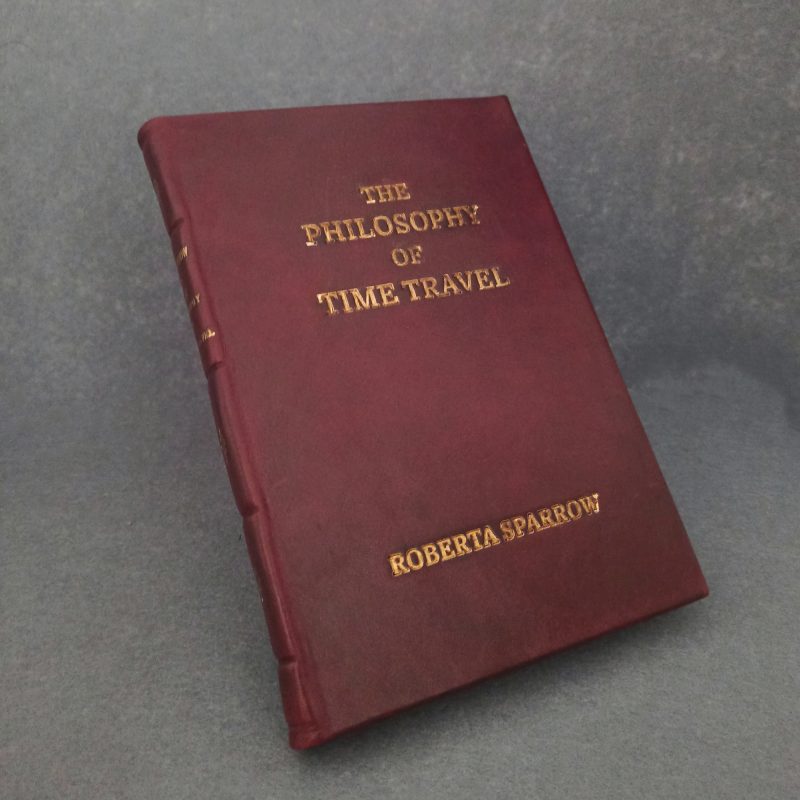
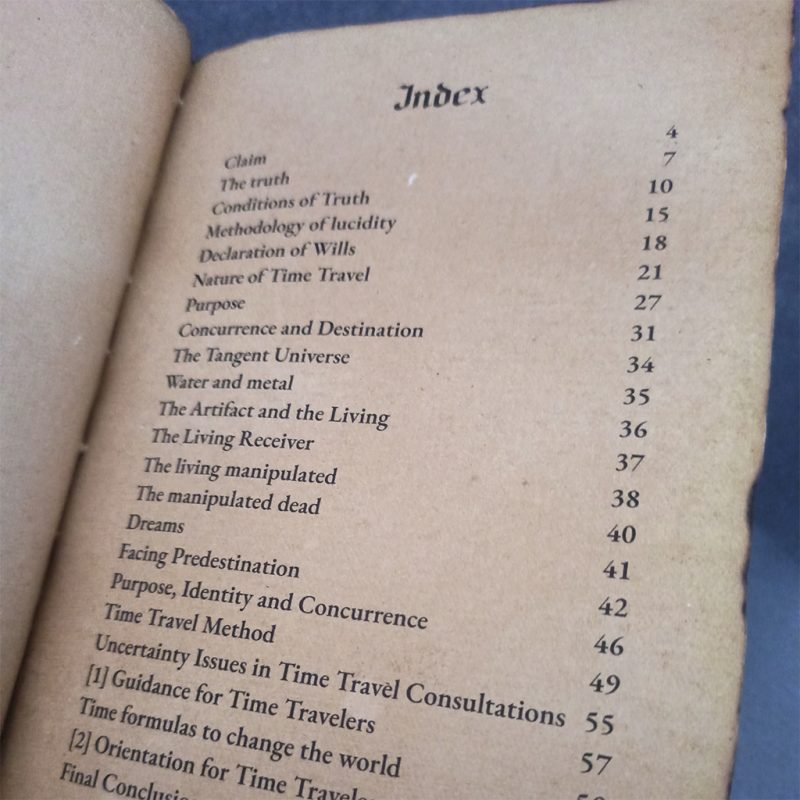
Reading for chrononauts · Limited edition
Philosophy can also cross time
A handmade work that explores the temporary traveler ethics, the concurrence of timelines, destiny and an introspective method to explore one's own history.
- Philosophy and moral standards for time travelers
- Tangent universes, causality, purpose and identity
- Illustrated and handcrafted A5 format
The file, availability and purchase are managed in Verbalus Mater.