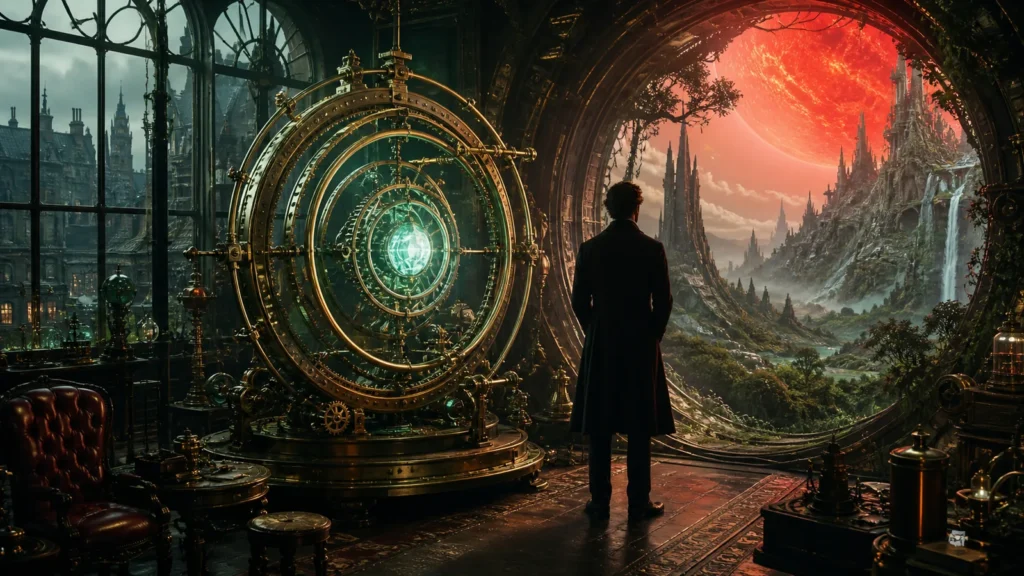
This analysis contains complete details of the novel. Published in 1895, The Time Machine established a decisive idea: time could be treated as a dimension through which a technology moved an individual. Before there were dreams, prophecies and supernatural journeys; Wells gave the traveler a device and an almost scientific speech.
The narrative framework
A narrator attends meetings of an inventor known as the Time Traveler. He presents a model, disappears briefly, and a week later arrives injured and exhausted. His story is embedded within the evening. The framework maintains a fertile doubt: the guests see evidence, but the expedition depends on the traveler's word.
The machine moves without traveling any appreciable space. The laboratory remains in the same place while the world accelerates around it: day and night merge, buildings appear and disappear and the vegetation changes. The image anticipates cinematic time-lapse and turns centuries of history into landscape.
The year 802,701
The traveler encounters the eloi, small beings who live among ruins, without apparent work or technical knowledge. First interpret that world as the triumph of a society without need. The disappearance of the machine and the existence of wells reveal the morlocks, underground inhabitants who maintain mechanisms and come out at night.
The relationship inverts the categories of the Victorian observer. The Eloi would descend from wealthy classes and the Morlocks from workers relegated underground. But economic dependence has turned into predation. Wells projects the inequality of his time until it transforms it into biological divergence.
Weena and the limit of progress
The relationship with Weena introduces care into a society that the traveler judges to be apathetic. It also exposes his tendency to turn inhabitants into evidence for a theory. The forest fire and the loss of Weena break the fantasy of control. Technology allows us to cross eras, but it does not guarantee understanding them or saving whoever we encounter.
Beyond humanity
After recovering the machine, the traveler advances millions of years. See an Earth under a huge Sun, crab-like creatures and finally a motionless coast with minimal life. The journey changes from social satire to cosmological vision. Humanity is not the final destination of evolution; It's an episode.
Victorian thermodynamics influence that twilight beach. The novel imagines a universe that loses usable differences and approaches exhaustion. Modern physics has refined stellar and cosmological evolution, but the intuition of an entropy arrow ultimately provides its force.
How does the machine work?
Wells offers no equations or fuel. The traveler compares duration with length, width and height, and maintains that our consciousness moves along the fourth dimension. Your device alters the speed of that traffic. It is a conceptual extrapolation, not a consequence of relativity: Einstein would publish special relativity ten years later.
The machine appears to isolate the user from ordinary interactions while accelerating. If it occupied the same space as the matter present on arrival, collisions would arise. The novel avoids the problem by making small displacements and keeping the pedestal accessible.
Journey to the future and relativity
Physics does allow a traveler to reach another's future by accumulating less time through high speed or gravity. But Wells's Traveler watches the ages pass from his seat and can stop almost at will, something that does not correspond to the time dilation. Its subjective clock and historical speed are decoupled by an invented property.
The final disappearance
The traveler sets off again with a camera and a backpack. The narrator waits for years. The flowers brought by Weena remain as material proof and symbol: the future contains degradation, but also gratitude. The final absence prevents closing the machine as a simple experiment; turns it into a modern myth.
How to draw the timeline without getting lost
The most reliable way to analyze The Time Machine by H. G. Wells It consists of separating three layers. The first is the order of presentation: what the work decides to teach us and the moment in which it reveals it. The second is the chronological order of events within the narrated world. The third is the time of each character, that is, the sequence that his body remembers even though the montage jumps from one date to another. In this case, the dominant model is a movement controlled by a single historical line towards increasingly remote futures. Mixing the three layers produces false contradictions; Keeping them separate allows us to locate the authentic mechanism of each turn.
A useful diagram starts with one arrow per character. Each departure, arrival, encounter with another version and transfer of information must be marked. Then the events that are the same event seen from different perspectives are joined. In The Time Machine by H. G. Wells, the point that organizes the map is the arrival in the year 802,701 and the loss of the machine on the pedestal of the White Sphinx. Around this node we understand why a scene that seemed like a cause can be, at the same time, a consequence of a subsequent action. It is not necessary to memorize dates: it is enough to follow what each person knows before and after crossing the temporal mechanism.
It is also important to distinguish a loop from a repetition. In a causal loop, an object, person, or piece of information returns to a previous point and helps produce the conditions of its own journey. In a repeat, the universe restarts an interval and characters may or may not retain memories. H. G. Wells's time machine works mainly with an open journey without a causal loop: the protagonist observes future consequences of previous processes. That choice determines what can be changed, what is fixed, and where the information that circulates comes from.
Causality, information and entropy
The central question is not only "how do they travel?" but "what happens to the cause?" A temporal history can be strange without being logically contradictory. If the past is unique and already includes the arrival of the traveler, each intervention must fit into the known facts: it is the idea that develops the consistency conjecture. If a decision opens another story, the conflict disappears because the consequences are distributed between branches. H. G. Wells's Time Machine does not attempt to modify its own past; uses the future as a laboratory of social and natural history.
The information deserves independent monitoring. A message can travel a circuit and have no external origin: someone learns it from their future version and later delivers it to their young version. Content exists throughout the curve, even if no one has created it from the outside. This type of bootstrap paradox It does not contain a formal denial, but it challenges our expectation that all complex information has a source. In the play, the Weena flowers return to the 19th century as evidence whose future origin tells of a relationship that the guests cannot verify.
Entropy adds another arrow. Microscopic laws are largely reversible, while macroscopic processes show statistical direction: heat flows, memories record the past, and a broken glass does not spontaneously mend itself. To truly invert a biography it would not be enough to project a film upside down. It would be necessary to specify what happens with metabolism, radiation, air, measurements and memory. appears in the degradation of structures, the transformation of species and the final vision of an exhausted Earth
This allows the work to be evaluated on two scales. As a physical mechanism, it may require nonexistent technology or prohibitive extrapolation. As a narrative device, it can be perfectly consistent and explore loss, freedom, identity or responsibility. Good criticism does not punish fiction for imagining; accurately identify which law it expands, which it breaks and what it dramatically gets in return.
The four scenes test
1. The first demonstration. The small model disappears before the guests and establishes that an object can leave its date without moving from the table. This scene establishes the contract with the viewer. We must ask what magnitude changes, who observes the phenomenon and what instrument detects it. If the effect only exists when the camera needs it, it's narrative magic; If it retains rules in subsequent situations, it constitutes a system.
2. The meeting between times. The traveler stops the machine before the eloi and discovers that his initial theory of progress is incomplete. Here asymmetric knowledge matters: one version can recognize the other while the second has not yet experienced the encounter. The emotion comes from that inequality. The viewer knows more than one character and less than another, so the editing turns a causal equation into suspense.
3. The apparent contradiction. The Morlocks reveal that superficial abundance depends on a history of division and exploitation. Before calling it an error, all readings must be tested: self-consistency, branching, incomplete information or mistaken identity. A genuine contradiction requires that the work simultaneously affirm a fact and its denial within the same story, not just conceal a cause until later.
4. The closure. The beach under the dying Sun expands the scale until it makes humanity a geological instant. The ending reveals the temporal philosophy of the work. A closed circle usually speaks of determinism; a branch, of opportunity; a repetition with memory, of learning; an unattainable future, of mourning. Temporal mechanics are not decoration: they organize meaning.
What fiction gets right and what belongs to conjecture
On the solid side are evolution, the depth of geological time, and the thermodynamic direction of macroscopic processes. They are ideas supported by proven theories or experiments and can be consulted in our guide to physics of time travel. In the speculative territory there remains a device that adjusts the temporal coordinate at will while remaining spatially immobile. A mathematical solution is not equivalent to an object that nature produces, and a possible object is not equivalent to a constructible machine with energy, control and security.
The decisive criterion is the scale. An effect can be measured and still be useless for the technological argument. Atomic clocks detect tiny dilations; that does not provide a door to the past. Quantum fields admit local negative energies; that does not deliver a stable macroscopic throat. The novel compresses tens of millions of years into a brief experience without the energy or acceleration that any relativistic mechanism would require.
Another issue is the frame of reference. Phrases like "time stops" tend to hide who the comparison is being made. A traveler's clock always ticks locally normally. The differences appear when comparing trajectories that separated and met again. The traveler keeps his watch while the outside accelerates; that decoupling is the fundamental fictitious rule.
Frequently asked questions
Does history have a single timeline?
Yes. The traveler visits successive stages of the same world and no branches are presented.
Can the characters change the past?
The novel does not prove a change from the past. His intervention in 802.701 can be incorporated without contradicting its century of origin.
Is there a grandfather paradox?
No. The conflict comes from social evolution, not from preventing the birth of the traveler.
Where does the necessary energy come from?
Wells mentions mechanisms and materials, but does not define a source capable of bending space-time.
Could it be reproduced today?
No. Even when the work starts from a real effect, the complete device requires conditions outside our capacity and, in several cases, outside any confirmed theory. Saying so does not reduce your interest: it clarifies the creative leap.
What theory should you read next?
The ideal comparison is real time dilation and, for the remote end, the relationship between time and entropy.
Conclusion: the temporal rule as a human portrait
Wells didn't hit a machine; invented a perspective. By placing a Victorian before the ruin of his own civilization, he turned the future into a critique of the present. Modern time travel is born there: an imaginary technology that allows us to examine what we believe is permanent.
The best way to return to H. G. Wells' The Time Machine is to do so with two maps at once: one records events, clocks, and information; the other records desires, losses and decisions. When both maps overlap, time travel stops being a trick. It becomes a way of asking what part of a life we would change if we could see it in its entirety, and what responsibility we would retain if we knew that our attempts to escape are also part of the journey.
Related reading: closed time type curves, the chronology protection and parallel universes.
Advanced reading: five checks for a second visit
1. Separate mechanism, rule and metaphor
The mechanism is the device or phenomenon that allows movement; the rule determines what consequences it admits; the metaphor explains why that choice matters. In The Time Machine by H. G. Wells, the mechanism includes an apparatus that adjusts the temporal coordinate at will while remaining spatially immobile; The central rule can be summarized as follows: Yes. The traveler visits successive stages of the same world and no branches are presented. The metaphor appears when that physical structure reflects the emotional experience of the character. Evaluating the three layers separately avoids two opposing errors: demanding laboratory precision from a metaphor or forgiving a contradiction in rules because the scene is emotional.
During a second visit, it is a good idea to write down each explicit statement about time and compare it with what really happens. Characters can make mistakes. A confidently spoken explanation is not necessarily the definitive law of the world; It can express partial information, propaganda, or a hypothesis. The strongest evidence is the consistent repetition of an effect under different circumstances.
2. Take version inventory
For each protagonist a list is written according to their personal experience, not according to the montage. The initial event of that inventory will be different for each age or address. In this work, The Traveler keeps his watch while the outside speeds up; that decoupling is the fundamental fictitious rule. Then you mark what memories you have in each encounter. Much of the temporal suspense arises when two bodies share space with unequal mental files.
This inventory also resolves apparent script holes. If a person does not act on information, we must check whether he already knows it at that point in his biography, whether he trusts the source, and whether doing so would produce the same event he intends to avoid. Causality does not eliminate psychology: knowing a result is not equivalent to understanding all its causes.
3. Track objects and messages
A key, a notebook, an equation or a scar can be better watches than a date. It is noted who owns them, what condition they are in and what version they are delivered. In H. G. Wells' The Time Machine, the Weena flowers return to the 19th century as evidence whose future origin tells of a relationship that the guests cannot verify. If the tour closes without a creation point, we are looking at bootstrap information. If an extra copy appears when changing a branch, the model needs to explain conservation and the relationship between stories.
4. Apply the energy and environment exam
The question "is it possible?" must be divided. First: does the geometry or the process have a mathematical model? Second: does the necessary matter exist? Third: can it be formed under realistic conditions? Fourth: does it remain stable under radiation and disturbances? Fifth: could a human being pass through it? In this case, The Novel compresses tens of millions of years into a brief experience without the energy or acceleration that any relativistic mechanism would require. Most fiction answers the first narrative question well and deliberately leaves the four engineering questions open.
The environment usually reveals the hidden jump. A person needs to exchange air, heat, light and forces with the world. A planet next to a compact object receives radiation and tides. A portal has borders and must affect fields. Adding those interactions is not meant to ruin the story; shows what simplification allows the concept to be visible on screen or readable in a novel.
5. Ask what would change if we removed the trip
If the argument worked the same by replacing the machine with a late letter, time would be decoration. It doesn't happen here. Wells didn't hit a machine; invented a perspective. By placing a Victorian before the ruin of his own civilization, he turned the future into a critique of the present. Modern time travel is born there: an imaginary technology that allows us to examine what we believe is permanent. The rule decides who can know, say goodbye, take responsibility or preserve memory. That is why the work remains valuable even if a device that adjusts the temporal coordinate at will while remaining spatially immobile remains outside confirmed science.
Temporal Model Quick Sheet
- Structure: a movement controlled by a single historical line towards increasingly remote futures.
- Loop type: an open journey without a causal loop: the protagonist observes future consequences of previous processes.
- Anchor point: the arrival in the year 802,701 and the loss of the machine on the pedestal of the White Sphinx.
- Solid scientific basis: the evolution, the depth of geological time and the thermodynamic direction of macroscopic processes.
- Speculative Leap: a device that adjusts the temporal coordinate at will while remaining spatially immobile.
This tab works as a consistency test. If an alternative interpretation contradicts two or more of your points, it needs explicit evidence in the work. If you keep them and explain a scene better, it can be a valid read. Rich temporal histories allow for ambiguity, but not just any rule at once.
Reading for chrononauts · Limited edition
Philosophy can also cross time
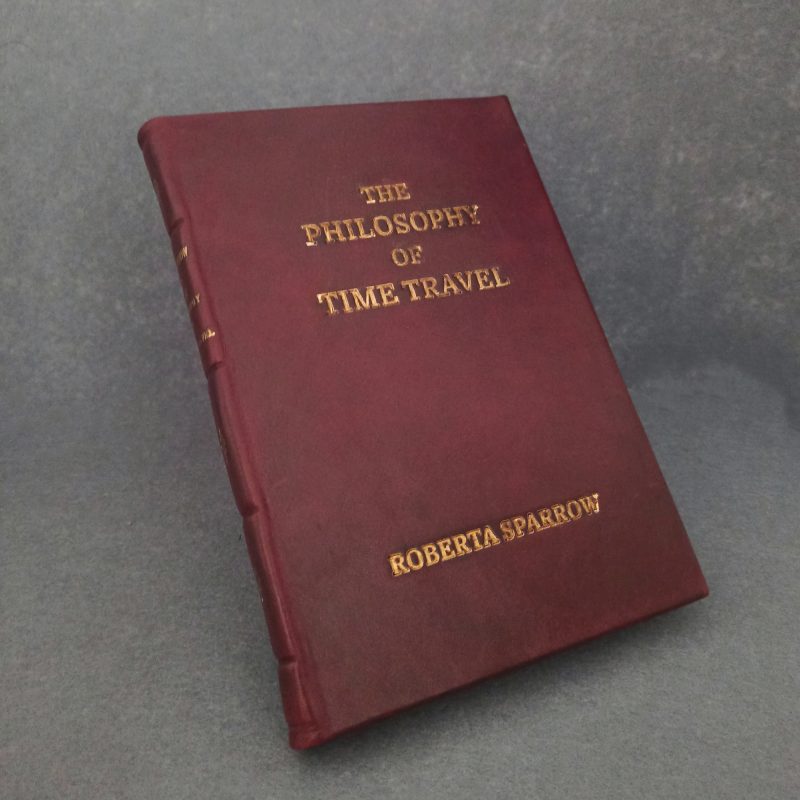
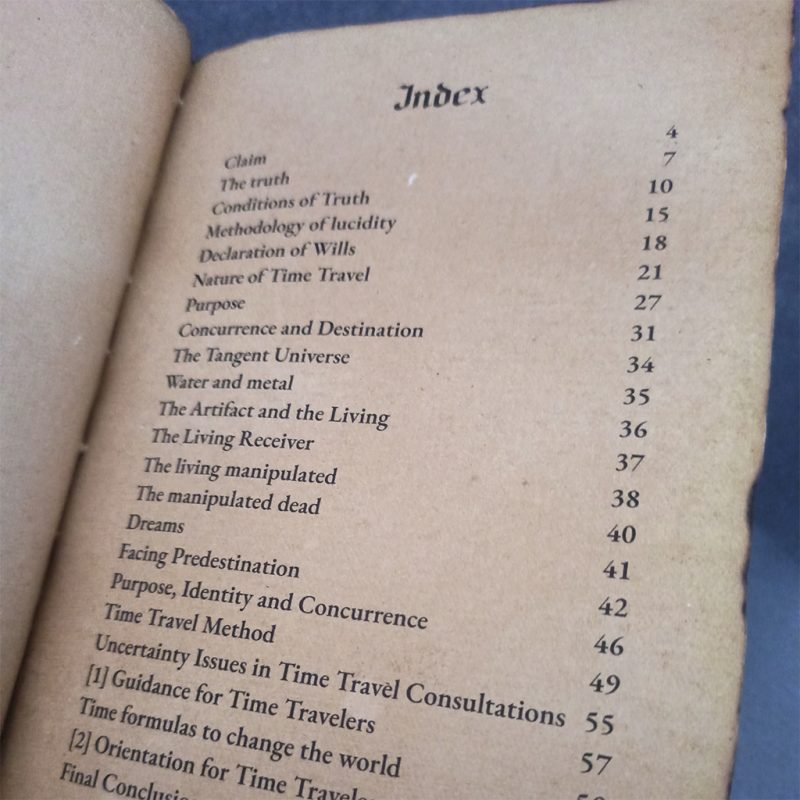
A handmade work that explores the temporary traveler ethics, the concurrence of timelines, destiny and an introspective method to explore one's own history.
- Philosophy and moral standards for time travelers
- Tangent universes, causality, purpose and identity
- Illustrated and handcrafted A5 format
The file, availability and purchase are managed in Verbalus Mater.